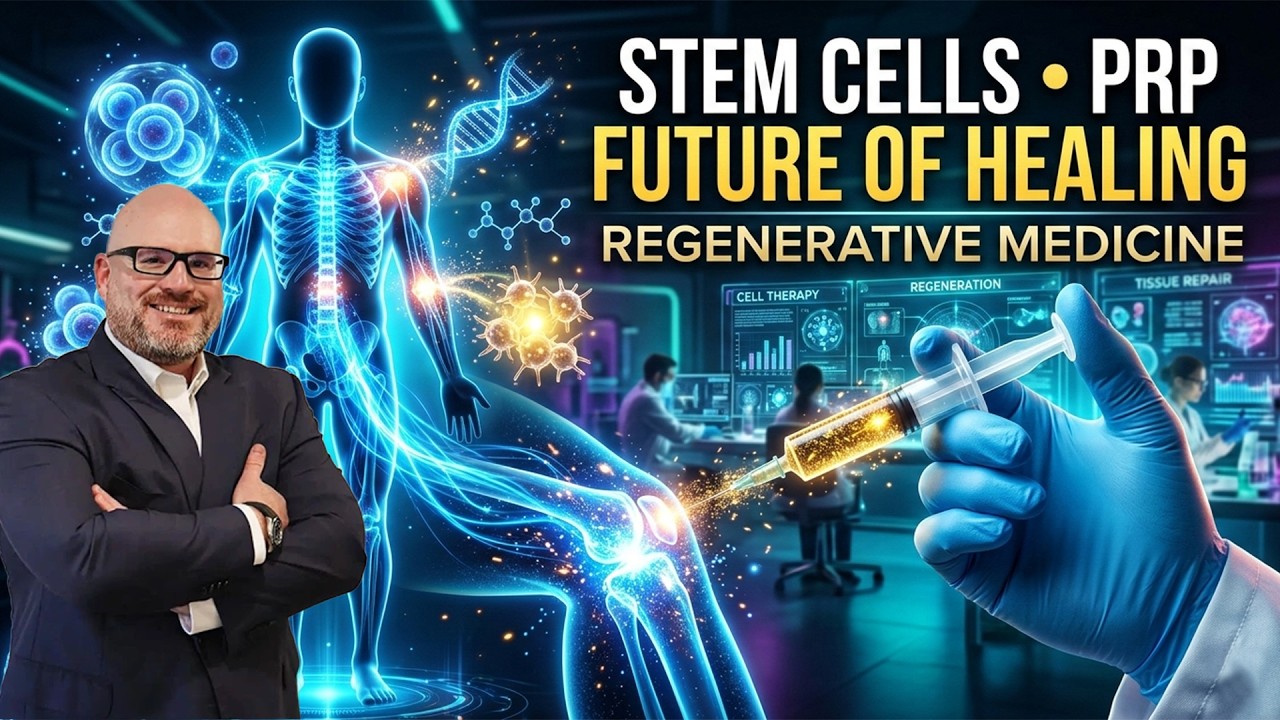
Sports medicine physician Dr. Daniel Savarino has spent the last 15 years working in regenerative medicine — starting with platelet-rich plasma (PRP), and for the past 12 years also using bone marrow aspirate, the source of the cells at the center of his practice. In this episode — released simply as "A Conversation with Dr. Daniel Savarino" — he sat down with host Mark Anthony to lay out, in plain language, what these treatments actually are, who tends to benefit, and where he draws hard lines around what he will and won't inject into a patient.
Dr. Savarino completed a family practice residency followed by a sports medicine fellowship, and runs a regenerative medicine practice in central New Jersey, on the Jersey Shore roughly halfway between New York City and Philadelphia. A theme he returned to throughout the conversation: most of the patients who come to him have already been told by an orthopedic surgeon that surgery is their only option — and while that's sometimes true, he said, in many other cases there are non-surgical steps worth trying first.
Key Takeaways
- Dr. Savarino's practice centers on two main tools — PRP and bone marrow-derived cell therapy — plus lower-cost prolotherapy for patients working within a tighter budget.
- He follows two self-imposed rules for every treatment: it must be autologous (the patient's own cells) and minimally manipulated (concentrated, never cultured or altered) — the same standard regulators require.
- He estimated that roughly 85 to 90 percent of appropriately selected patients see good to excellent results, but was clear that patients with severe, uniform joint damage and little remaining range of motion are less likely to benefit.
- He described a patient — an elite-level CrossFit athlete with a shoulder labral tear who had been told she needed surgery — who was back to overhead pressing 150 pounds about eight weeks after a combined bone marrow and PRP treatment.
- Cost, not safety, was the barrier he pointed to most: regenerative treatments are largely not covered by insurance, which is why he offers options across a range of price points.
PRP, Bone Marrow Stem Cells, and Prolotherapy: The Three Tools, Ranked by Cost
Dr. Savarino walked through the main treatments he uses, from most to least expensive:
- Bone marrow-derived cell therapy: what he's focused on for the past 12 years. Cells are drawn from the patient's own bone marrow, concentrated, and injected into cartilage, meniscus, labrum, or other joint tissue. He noted that current guidance discourages calling these cells "stem cells" — the more precise term is mesenchymal, or "medicinal signaling," cells — and that the benefit doesn't come from the cells directly turning into new tissue so much as from the growth and healing factors they release once injected.
- PRP (platelet-rich plasma): a patient's blood is drawn and spun down to concentrate platelets, which are then injected into the injured area. He cited research showing PRP outperforms steroid or hyaluronic acid injections for knee arthritis, and said it also works well on tendons, ligaments, and muscles — though some patients need more than one round to get a result, which can narrow the cost gap with bone marrow treatment. He also described a further-processed version of PRP, filtered to concentrate extracellular vesicles alongside the platelets, as a middle-cost option for patients who want more than standard PRP without the full price of bone marrow treatment.
- Prolotherapy: the lowest-cost option, using a dextrose (sugar-water) injection to trigger a controlled inflammatory response and draw more blood flow to an area. Dr. Savarino called it "probably the original regenerative medicine," in mainstream use for at least 25 years — though it typically takes more sessions, sometimes five or six, roughly weekly, to reach a comparable result.
Why He Only Uses a Patient's Own Cells
Dr. Savarino was direct about where he draws the line on sourcing. He doesn't use umbilical cord or Wharton's jelly-derived products, citing unresolved legal questions and pointing to an FDA warning issued a few years ago about unapproved umbilical stem cell products still being marketed despite it. His preference for a patient's own cells isn't just about caution — he cited a study showing that a person's own stem cells remain viable well into the ninth decade of life, countering the pitch some providers make that older patients' own cells are too old to be effective.
"My two rules are autologous — it's your own body going back into you — and minimal manipulation, meaning we can concentrate it and spin it down, but we're not allowed to add anything or culture it. That's where these places get into trouble when they're not supposed to."
— Dr. Daniel SavarinoA Patient Who Avoided Shoulder Surgery
Asked for a specific example, Dr. Savarino described a patient who was an elite-level CrossFit athlete with a labral tear in her shoulder. She'd been told she needed surgery and hadn't been able to do overhead military pressing for more than a year. After reviewing her MRI, he treated her with a combination of bone marrow-derived cells and PRP instead. He noted that most patients take about six to eight weeks to notice a change, but because she was young, healthy, and active, she was back to it faster — sending his practice a video of herself overhead-pressing 150 pounds around the eight-week mark. He was careful to frame it as one case rather than a guarantee, and noted that patients who are bone-on-bone across a joint with no meaningful range of motion left are unlikely to see the same kind of result.
Who Sees the Best Results — and What Holds Patients Back
When asked for a rough success rate, Dr. Savarino said that of the patients he treats, roughly 85 to 90 percent see good to excellent results — with the caveat that outcomes depend heavily on choosing appropriate candidates in the first place, not on the treatment alone. He described his approach as individualized rather than protocol-driven: rather than committing a patient to a fixed course of, say, three PRP injections two weeks apart, he waits to see how a first treatment responds over six to eight weeks before deciding whether another is warranted.
The main downside he pointed to wasn't clinical — it was financial. Regenerative treatments are largely not covered by insurance, which he said puts them out of reach for some patients regardless of how well they might work. That's part of why he offers options across different price points, letting patients weigh cost alongside the specifics of their injury rather than defaulting to the most expensive option by default.