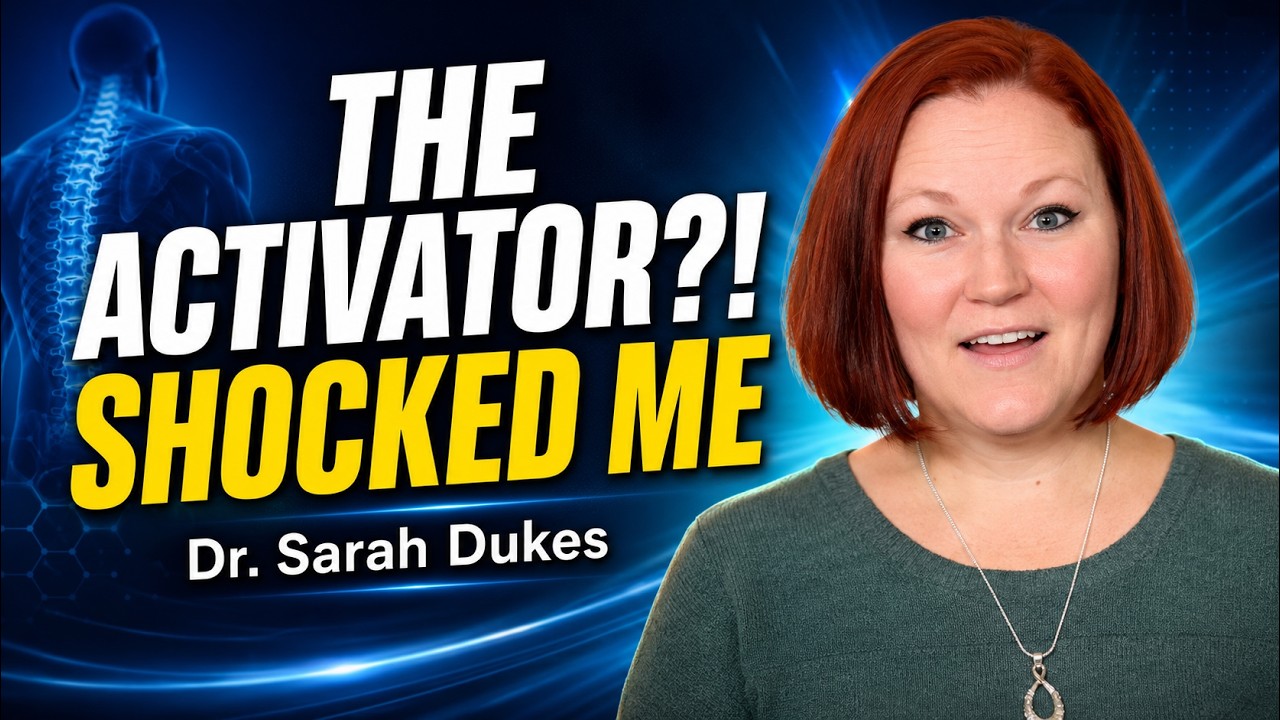
Most people picture a chiropractic visit as a twist, a pop, and a crack. Dr. Sarah Dukes, a chiropractor who has spent nine years running an Austin, Texas practice with her husband, spent this conversation with Mark Anthony describing a different tool entirely: a small, spring-loaded, calibrated instrument called the Activator, which she says can adjust a joint without any of the aggressive movement most people associate with the profession.
Dukes found chiropractic care at 23, while pregnant, after years working as a massage therapist. She and her husband — a massage therapist of more than three decades — built their practice together after she finished chiropractic school. Her own introduction to the Activator specifically came a bit later, during a class in that same program: after the birth of her third child left her with a severe hip injury and barely able to walk, an instructor pulled her out as the class example, ran the full Activator protocol on her, and — in her words — she walked out of that class pain-free.
Key Takeaways
- The Activator Method uses a calibrated, spring-loaded handheld instrument to move a joint by a matter of millimeters — no twisting, no cracking, no cavitation sound.
- Dukes described it as guided by muscle testing to pinpoint exactly which spinal segments need attention, and called it one of the more heavily researched techniques in chiropractic.
- It's often the better option for patients who can't tolerate manual adjustment — including those with severe neurological conditions, extreme ligament laxity (Ehlers-Danlos syndrome), or advanced osteoporosis.
- Dukes runs her practice roughly 50/50 between Activator and traditional manual adjusting, letting each patient's condition, history, and comfort guide the approach.
- She described specific cases — including an MS patient who fell less often at home after two or three sessions, and a nonverbal autistic child who became verbal after roughly three months of care — while being careful to frame outcomes as case-specific, not guaranteed.
What the Activator Method Actually Is (And Why There's No "Crack")
Dukes described the Activator as a handheld instrument that's calibrated for the specific joint and amount of pressure needed, then placed directly against the area and triggered with a click. She uses muscle testing beforehand to figure out which segments are "out" and need correcting. There's no spark, no air, nothing dramatic — just a precise, calibrated pressure that nudges the bone into place.
The contrast with manual adjustment, in her telling, comes down to force and specificity. A traditional adjustment can involve breaking through resistance in the body, which some patients tolerate well and others don't. The Activator instead moves the joint "millimeters," working with the body rather than against it. She called it one of the more scientifically researched techniques in the chiropractic field.
"I get a lot of people who say, 'What on earth — what kind of voodoo was this?' I'm like, it's the best kind of voodoo."
— Dr. Sarah DukesWho a Low-Force Adjustment Helps Most
Dukes estimated that only a small share of the population — she put it at roughly 2 to 5 percent — ever sees a chiropractor in the first place, and said a lot of people who might benefit stay away because they're uneasy about being touched or worried about the intensity of a manual adjustment. She sees the Activator as a way to bridge that gap.
Clinically, she said she reaches for it first with patients who have Ehlers-Danlos syndrome, a condition involving extreme ligament laxity, as well as patients with severe neurological issues who simply can't tolerate manual adjusting. She'll also steer new patients toward the Activator if they mention a bad prior experience with a chiropractor. From there, patients are free to ask for more — some want manual adjusting everywhere except the neck, for example, and her own husband asks for Activator only when he's significantly injured, manual adjustment when he's not. She said her practice today runs close to an even 50/50 split between the two approaches, guided largely by what each patient wants and what their consult suggests.
Real Cases Dukes Described From Her Own Practice
Beyond her own pain-free experience in chiropractic school, Dukes pointed to several specific cases. She described a patient with MS who came in struggling to walk; after two or three Activator treatments, he was reportedly falling less often at home. Years earlier, a few years out of school, she covered the practice of an elderly Austin chiropractor — she guessed around 80 — after he had a stroke. His patients skewed elderly too, many with severe osteoporosis and other degenerative conditions that made manual adjustment impossible. Watching them improve using only the Activator, she said, is what convinced her to add the technique to her own practice.
She also described one of her more challenging early cases: a young patient with severe nonverbal autism, for whom the Activator was the only tool he could tolerate during difficult sessions. Over roughly three months of treatment, she said his nervous system "started regulating" and he became verbal — a result she described as one of the more dramatic things she's witnessed, while being clear that she was simply introducing stimulus to the nervous system, not promising the same outcome for every patient.
A Practice Built Around Options
Alongside manual adjusting and the Activator, Dukes said her practice offers gua sha-style scraping — using stainless steel, buffalo horn, and jade tools to work through built-up scar tissue in problem areas — plus cupping. Her husband, a massage therapist of more than three decades, specializes in Lomi Lomi (a flowing, Hawaiian-style massage) and craniosacral therapy, a light-touch technique they'll often reach for first with patients who've been to multiple doctors without answers. At the time of this conversation, marking the practice's ninth year in business, Dukes mentioned a limited-time anniversary promotion on services and add-ons like cupping and gua sha; anyone interested should confirm current pricing directly with the practice rather than relying on that detail here.
Taken together, it's a useful listen for anyone who's avoided chiropractic care because of the "crack," anyone managing a condition where manual adjustment isn't an option, or anyone simply curious what a calibrated, low-force alternative actually looks like in practice.