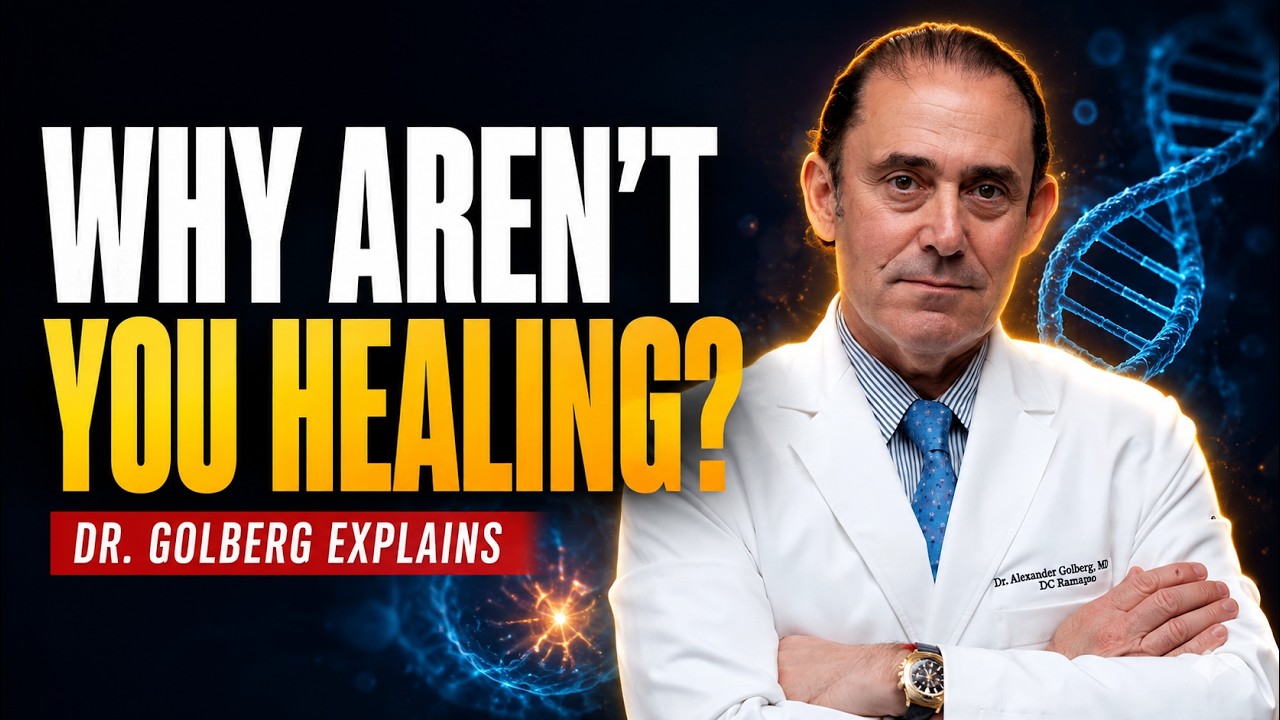
The title of this conversation is also its thesis: the body was built to heal itself, and the job of medicine — done well — is to stimulate that ability rather than override it. That's the case Dr. Alexander GolBerg made across this wide-ranging conversation with Mark Anthony, moving from osteopathic philosophy to GLP-1 peptides to why he thinks a lot of back and knee surgery gets scheduled too fast.
GolBerg's path into medicine started with a first medical degree earned in the Soviet Union, before he left the country 36 years ago at around 24 years old, speaking little English. He worked as a cab driver, bus boy, and waiter before finding a New York osteopathic medical school with a program for foreign-trained physicians — a program that, he said, gave him the philosophical foundation of his practice: that the body's structures are interrelated and have a natural ability to heal, and that the physician's job is often to help balance and stabilize that system rather than simply treat whatever symptom shows up. He opened his own practice, Dr. GolBerg Functional & Aesthetic Medicine, in Manhattan more than 25 years ago, and today also sees patients from a second, smaller office in Brooklyn.
Key Takeaways
- Dr. GolBerg builds his longevity approach on a foundation of lifestyle modification first — diet, sleep, movement, and rest — with biomarker and genetic testing layered on top, not used as a substitute.
- He pointed to chronic inflammation, highlighted by the "cytokine storm" of severe COVID-19, as a root driver of aging — damaging the lining of blood vessels in ways that raise long-term risk for heart disease and cognitive decline.
- He warned strongly against sourcing peptides through unregulated, unprescribed channels, stressing the need for physician oversight, blood work, and thyroid monitoring.
- He cited research suggesting MRI findings for disc and meniscus issues often don't correlate with actual pain, and said he has steered many patients away from scheduled back or knee surgery when no real neurological deficit was present.
- In his aesthetic practice, he favors combining PRP, PRF, and thread treatments over heavier filler, aiming for what patients describe as a "refreshed," not obviously altered, look.
The Root Idea: Balance the Body Before You Chase Biomarkers
GolBerg described a technique central to his practice called the primary respiratory mechanism — a subtle, self-regulating rhythm he says is present in the body from before birth, which trained physicians can learn to feel and balance by hand. He compared the underlying idea to acupuncture's meridian system: different language, similar principle, that the body's systems need to be in balance before they can function well.
From there, he builds what he calls a pyramid, with lifestyle — diet, sleep, exercise, and rest — as the base, and genetic and biomarker testing layered on top to catch problems early. As an example, he cited the APOE4 gene, carried by an estimated 75 million Americans, which roughly doubles a person's lifetime risk of Alzheimer's disease from about 10–12% to about 25%. His point wasn't fatalism about genetics — he said lifestyle modification alone can bring that elevated risk back down toward baseline. He also singled out chronic inflammation as a central driver of aging, pointing to what he called the "cytokine storm" seen in severe COVID-19 cases as a real-world example of inflammation damaging the inner lining of blood vessels, in ways he believes are now contributing to increased rates of heart disease and memory decline in patients who were seriously ill.
"Everything is good in moderation. That's the key — balance and moderation."
— Dr. Alexander GolBergPeptides, GLP-1s, and Why He Says Oversight Matters
Peptides came up as one of the biggest current trends in the wellness space, and GolBerg was candid about both sides of it. He noted that insulin was arguably the first peptide drug in medicine, and that GLP-1 agonists — the class behind today's diabetes and weight-loss medications — have been on the market for roughly 15 years. He shared a personal example: after reading a small study out of a Swedish medical journal suggesting a possible slowing effect on Parkinson's disease, he began giving one of the oldest GLP-1 medications to his own father, who had been diagnosed with Parkinson's. His father lived another 15 years, to age 84.
At the same time, GolBerg was blunt about the risks of the unregulated peptide market — describing supply chains that trace back to countries where the products are prohibited, and patients obtaining them without ever seeing a doctor or getting bloodwork. He said his own patients get regular thyroid ultrasounds and blood monitoring while on peptide therapy, noting that GLP-1 use carries a rare but real thyroid cancer risk that needs supervision. His overall framing: peptides are a tool, not a magic bullet, and they need to be part of an individualized plan run by a physician — not something ordered online after a single virtual consultation.
Regenerative Medicine: PRP, PRF, and the MRI Over-Diagnosis Problem
GolBerg's regenerative work started roughly 25 years ago, when — early in a family-medicine practice focused on elderly patients with degenerative joint disease, spinal stenosis, and chronic pain — he found the standard toolkit of injections and opioids limiting. He traveled to Germany to learn platelet-rich plasma (PRP) technique, and has been injecting joints, backs, and necks with it ever since. About seven to ten years ago, he largely shifted to PRF (platelet-rich fibrin), a closely related technique that skips the anticoagulant used in PRP, a method he said was pioneered in dentistry for bone grafting. He also uses exosomes and, for research purposes only, umbilical cord-derived material — he was explicit that this application is not FDA-approved — noting that quality and screening of donor material vary widely across the industry and that this is where an individual practitioner's judgment matters most. He drew a clear distinction between the two: stem cells could theoretically carry cancer risk if sourced from compromised tissue, he said, while exosomes carry no DNA and, in his view, do not.
He was also skeptical of how quickly imaging leads to surgery for back and knee pain. He referenced a study — he acknowledged he didn't recall the exact sample size — comparing people with chronic back pain to people without any, which found disc abnormalities on MRI in both groups about equally often, undercutting the idea that a "bad disc" on a scan reliably explains pain. In his view, surgery for a herniated disc is clearly warranted when there's an actual neurological deficit, such as loss of bowel or bladder control, but often isn't otherwise. He made a similar point about knee meniscus surgery, citing recent research suggesting it doesn't outperform non-surgical care for many patients and may even accelerate arthritis in the joint.
Aesthetic Medicine: A "Refreshed," Not "Frozen," Philosophy
GolBerg also runs an aesthetic practice, which he says grew directly out of his regenerative work rather than starting separately. When fillers and neuromodulators like Botox became mainstream over 20 years ago, he says he watched the trend toward an overfilled, "frozen" look and instead began applying PRP to the face and scalp. He later added polydioxanone thread treatments — sutures originally developed to close the sternum in open-heart surgery, which were found to stimulate collagen production and were adapted for aesthetics by a family of plastic surgeons in the country of Georgia. By combining threads with PRP and PRF, he said he's able to get results that last up to about 18 months, with less downtime, less pain, and meaningfully lower cost than a surgical facelift — while stopping well short of surgery's longer-lasting results. His stated goal is for patients to look like themselves, only rested: "You just came back from vacation," is the reaction he says he hears most, not questions about what work was done.
Who This Conversation Is For
GolBerg also weighed in on AI's growing role in medicine, calling it a genuinely useful tool for organizing biomarker data and information — but insistent that it can't replace a physician sitting with a patient, listening to their history, and, as he put it, feeling for a pulse AI doesn't have. If you've been told your only options are surgery or another prescription, or you're curious about the difference between PRP, PRF, and stem cell therapy, or you want a physician's candid read on the peptide trend, this episode is a useful, plain-language primer from someone who has practiced across both conventional and osteopathic medicine for three decades.