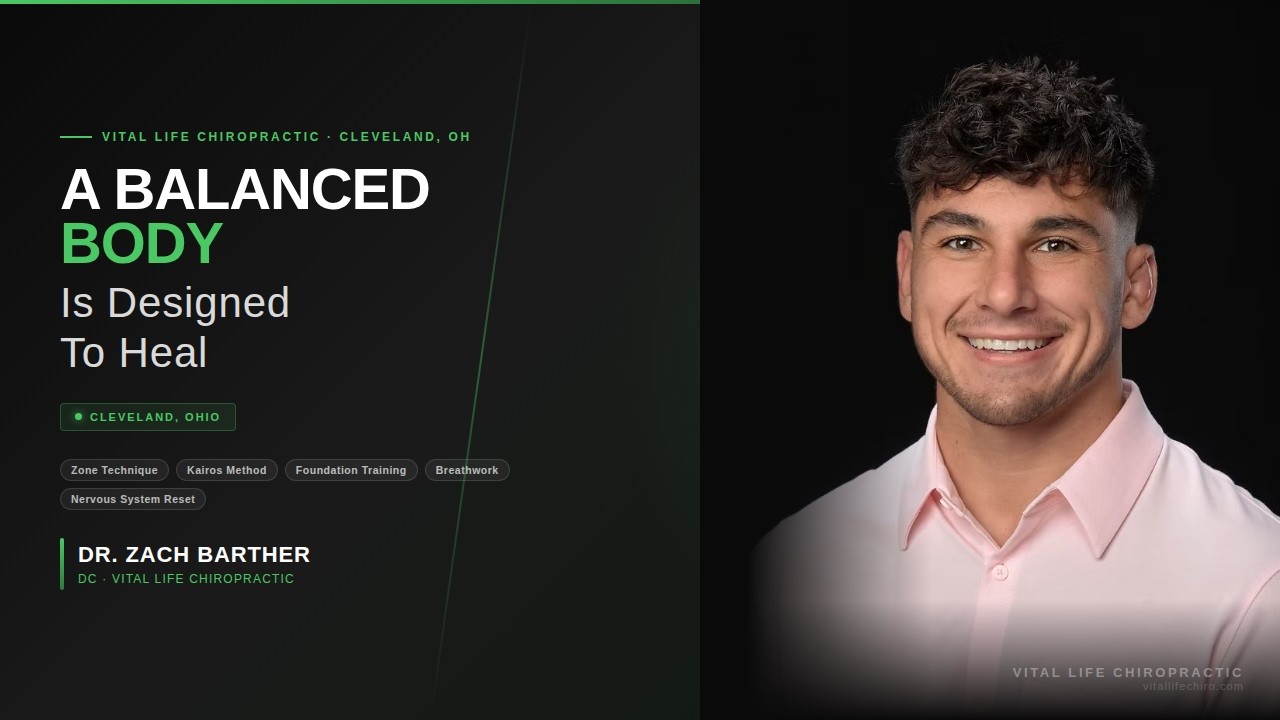
"A balanced body is designed to heal." That's the line Dr. Zach Barther, DC opened with when he sat down with Mark Anthony — and the rest of the conversation was him unpacking exactly what he means by it. Barther is a Doctor of Chiropractic and founder of Vital Life Chiropractic in Cleveland, Ohio, which he opened in April 2026 after several months working alongside an established chiropractor in the Seal Beach area of California. His approach centers on what chiropractors call innate intelligence — the idea that the body already knows how to heal itself, and that the nervous system is the wiring that lets it do so.
For Barther, that isn't an abstract idea — it's personal. He traced his path into chiropractic back to a childhood illness, a serious high school football injury, and a pandemic-era realization about health and immunity that pushed him to make the field his career.
Key Takeaways
- Barther's core philosophy: healing comes from the body's own "innate intelligence," not from something added from the outside — chiropractic care aims to remove nerve interference so that intelligence can function fully.
- He uses the Zone Technique, which divides the body into six systems — glandular, eliminative, nervous, digestive, muscular, and circulatory — each tied to a region of the brain and addressed through specific points along the spine.
- Care frequency is individualized: new patients start with a 45-minute-to-hour comprehensive exam, with typical plans beginning at two to three visits a week before tapering toward roughly weekly maintenance care.
- He described a "subluxation" — a spinal joint not moving properly — as being driven by three factors: thoughts, physical trauma, and toxins, not just physical injury alone.
- His own path into the field traces back to a high school football injury — a torn labrum, a broken collarbone, and a broken scapula — that he says resolved through chiropractic adjustments instead of the surgeries two orthopedic surgeons had recommended.
A Health Journey That Started in Childhood
Barther told Mark Anthony that his relationship with the body's ability to heal started when he was two years old, after he was diagnosed with nephrotic syndrome — a kidney condition, he explained, in which the body loses protein through urine and becomes significantly inflamed. He said conventional treatment escalated to steroids and, at one point, a chemotherapy overdose, without his condition turning around. With his family "at wits end," they sought out a local prayer healer; Barther said that in the following weeks, his bloodwork came back balanced for the first time. He described the experience as the origin of his belief in what chiropractors call innate intelligence — a concept he says he encountered years before he ever set foot in a chiropractor's office.
The idea solidified for him in high school. Playing running back, he was tackled and landed hard on his shoulder. His athletic trainer initially called it an AC joint sprain and cleared him to keep playing; when the pain hadn't improved weeks later, his mother took him for imaging, which turned up a torn labrum, a broken collarbone, and a broken scapula. Two orthopedic surgeons recommended two different surgeries — each, he said, carrying roughly a year of recovery that would have sidelined him from basketball and baseball. Instead, his mother brought him to her chiropractor, who focused on the nerves in his neck feeding into the injured shoulder. Barther said a few weeks to a month of adjustments got him healthy enough to play basketball that same season, without the surgeries.
That experience became his template, he said, and part of why he studied exercise science in college. The second turning point came during COVID-19: he said the public messaging he heard from chiropractors at the time — build resilience through vitamin D, sunlight, spinal health, and a lower resting heart rate, rather than simply waiting for a treatment — resonated with him as a lifelong athlete, and pushed him fully toward the profession.
Inside the Zone Technique: Six Systems, One Nervous System
Barther described the technique he uses in his office, called the Zone Technique, which breaks the body into six systems, each correlated with a region of the brain: the glandular system (hormone-producing glands like the thyroid, pituitary, and adrenals), the eliminative system (sinuses, lungs, kidneys, intestines), the nervous system (brain, spinal cord, and sense organs), the digestive system, the muscular system (muscles, tendons, ligaments), and the circulatory system (arteries, veins, lymph). A new patient's first visit, he said, runs 45 minutes to an hour and includes a detailed history aimed at identifying which system is out of balance — not just how close a person is to disease, he said, but how close they are to their full 100%. From there, he stimulates specific points along the spinal cord tied to the system that needs support.
He explained the nervous system as the body's "master control system" and, physically, its major highway: nerve roots exit the spine between each vertebra and connect to every muscle, organ, and tissue. When those joints are misaligned or restricted, he said, they can send too much or too little signal to whatever they serve. As one example, he described the nerve roots exiting around L4-L5 — commonly associated with low back pain — as also serving the reproductive organs, and said he has seen men with both back pain and erectile dysfunction improve on both fronts once movement was restored to that part of the spine.
"There's this life inside of us, and that's the only thing that does the healing, that does the rejuvenating — that animates our life. As a chiropractor, we work with that. We don't want to add anything else to the body. We just want to allow that intelligence to express itself."
— Dr. Zach Barther, DCSubluxation, Stress, and the Body's Two Gears
Barther walked through the chiropractic term "subluxation" — a spinal joint that isn't moving the way it should be. He broke the word down as "sub," meaning less than, and "lux," meaning light or life: a joint stuck out of proper motion, he said, means the body is expressing less life than it's capable of. He named three things that can contribute to it: thoughts, physical trauma, and toxins — and said mental and emotional stress belongs on that list just as much as an injury does, describing how something as simple as a scary movie can measurably change how a person's body feels in the moment.
He explained this through the two branches of the autonomic nervous system: the sympathetic "fight or flight" state, where blood shifts toward the muscles and away from digestive and reproductive organs, and the parasympathetic "rest and digest" state, where the body is meant to spend roughly 80% of its time. Modern life, he said, keeps people cycling into sympathetic mode over comparatively low-stakes stressors — traffic, a demanding work deadline — in a way that tenses muscles, locks up the spine, and restricts blood flow to the rest of the body's systems over time.
How Often to Get Adjusted — and What to Look For in a Chiropractor
Asked how often someone should see a chiropractor, Barther said it's case by case. A new patient with a longstanding issue might start at two to three visits a week; a high school athlete with a fresh, minor injury might need just a couple of weeks at two visits a week before tapering off. He said he personally gets adjusted once or twice a week even without pain or symptoms, and described roughly once-weekly care as "the gold standard" once a patient is out of pain and focused on wellness and performance rather than injury recovery.
His advice for someone looking for a chiropractor: find one who treats the whole person rather than just back and neck pain, is willing to put together a multi-month plan rather than one-off visits, and incorporates movement work — he mentioned classes like Foundation Training and breathwork as things his own practice offers alongside adjustments. He also talked about the feel of his office itself: leather treatment tables built to look like a couch, plants, and art, intentionally designed to feel less like a sterile clinical space. Above all, he told listeners not to reach for medication at the first sign of a minor symptom like a cold, framing symptoms as the body doing its job rather than something to immediately suppress — while still pointing people toward a chiropractor, rather than self-diagnosis alone, for ongoing guidance.