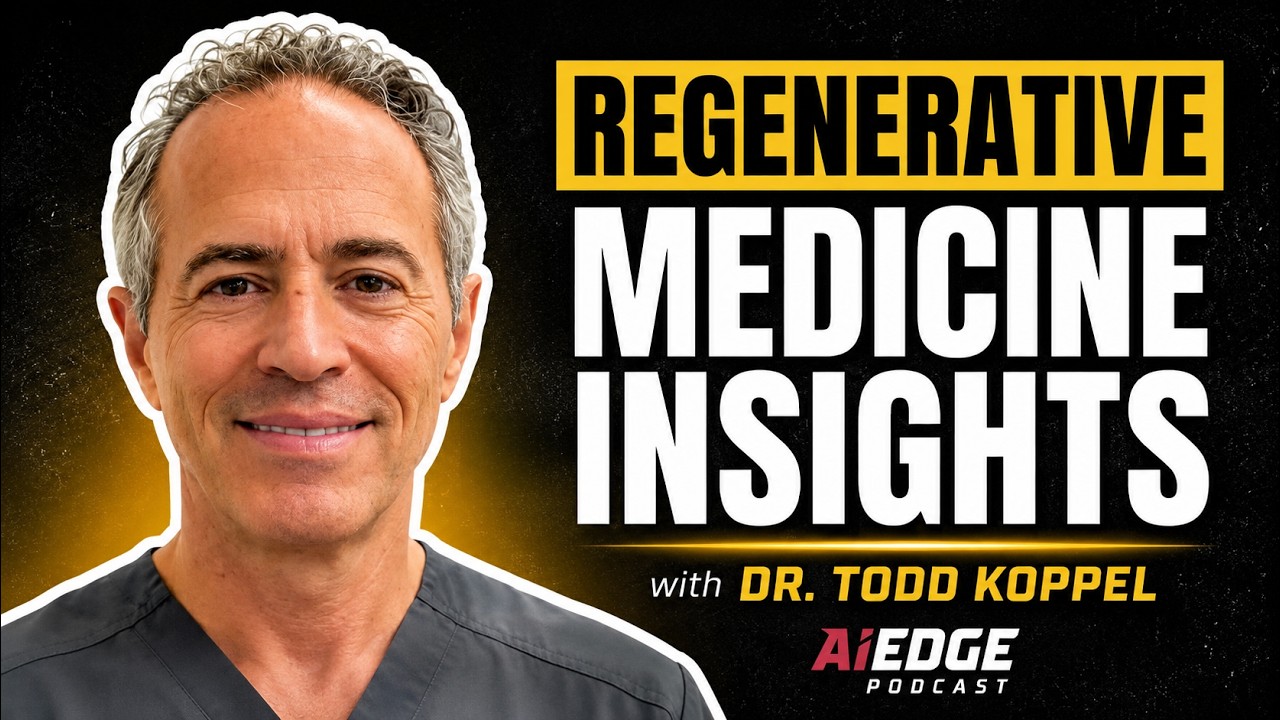
For patients living with chronic neck or back pain, "you need surgery" can feel like the end of the conversation. Dr. Todd Koppel, MD, joined Mark Anthony on Great Minds of Today to make the case that, for a lot of patients, it's actually the middle of one — and that a systematic, non-surgical workup often turns up options most people never hear about.
Koppel is a board-certified, fellowship-trained interventional pain management specialist at Garden State Pain Management in Clifton, New Jersey. He trained at Cornell University Medical College, completed an anesthesiology residency in 1996, and finished a pain management fellowship at the Hospital for Special Surgery in New York in 1997 — putting him close to three decades in practice at the time of this conversation.
Key Takeaways
- Regenerative medicine uses the body's own healing processes — PRP, stem cell therapy, and shockwave among the tools — to try to heal or regenerate tissue rather than bypass it with surgery.
- PRP concentrates a patient's own platelets from a blood draw and works best on tendinopathy (golfer's elbow, tennis elbow, pickleball elbow); Dr. Koppel does not recommend it for a full-thickness tendon tear, which typically needs to be surgically repaired.
- Stem cells, drawn from the patient's own hip bone marrow, carry more regenerative potential than PRP — he described PRP as the "low-test gasoline" and stem cells as the "high-test gasoline."
- Before recommending any treatment, Dr. Koppel works to identify the real "pain generator," since MRIs commonly show abnormalities — including in asymptomatic people — that may not be the actual source of pain; he said facet joints, not the disc, are the cause roughly half the time.
- He told Mark that around 99% of his patients improve with conservative and interventional treatment and avoid surgery altogether, though some cases — like a fully retracted rotator cuff tear — still require it.
What Regenerative Medicine Actually Means
Koppel opened by pushing back gently on how loosely the term gets used. "Regenerate" implies making new tissue, he said, but past age 30, the body's default direction is the opposite — degeneration, not regeneration, driven by years of activity and wear on joints and soft tissue. Regenerative medicine, in his framing, is an attempt to work with the body's own healing mechanisms to slow or reverse that process on a localized basis: healing tissue, and in some cases regenerating it, rather than simply masking pain.
The two "own-body" tools he discussed are PRP and stem cells. PRP is made by drawing a patient's blood, centrifuging it to concentrate the platelets — he noted the average person has roughly 250,000 platelets per milliliter of blood, and a typical office procedure concentrates that by around 50 times — and injecting the concentrate back into the injured area. Platelets carry growth and healing factors, and he said they've shown particular benefit for tendinopathy conditions like golfer's elbow, runner's knee, and tennis or pickleball elbow. Stem cells go further: drawn from the patient's own iliac crest (hip bone marrow) under local anesthetic, they carry a greater theoretical capacity to actually regenerate tissue rather than just calm it down.
"PRP is your low-test gasoline, and stem cells are your high-test gasoline. Low-test gasoline gets you from A to B — it works. But if you use high test, it'll do it more efficiently. It'll do a better job."
— Dr. Todd Koppel, MDFinding the Real "Pain Generator" Before Treating Anything
A recurring theme was diagnostic discipline. Koppel was direct that an MRI is "a computer-generated image, not an actual picture," with real rates of false positives and false negatives. He cited a decades-old study in which researchers MRI'd 100 people with no history of back pain and found that 40 to 50% still showed spinal changes — bulges, and in some cases fully asymptomatic herniations. His point: "it's normal to be abnormal" on imaging, especially with age, and the clinical work is figuring out which finding, if any, is actually causing a given patient's pain.
That workup often points away from the disc entirely. Koppel explained that the facet joints — small joints toward the back of the spine, distinct from the disc — are the source of the pain roughly half the time in his experience, alongside supporting muscles, nerves, and ligaments. He calls the process of isolating the true source the search for the "pain generator," and it drives everything that follows: a new-patient consultation runs 20 to 30 minutes and works through pain history, aggravating factors, prior imaging, and any relevant injury before an algorithmic sequence of diagnostic and interventional treatments narrows down the actual cause.
PRP, Stem Cells, and Shockwave in Practice
Once a structure is identified, Koppel described several ways regenerative tools get applied to the neck and back specifically. PRP or stem cells can be injected around — not into — an irritated nerve root, in the neuroforamen, to help calm nerve inflammation. They can also be injected directly into a degenerated disc: he referenced a study in the lower back where a "dusky," dehydrated-looking disc on MRI — most commonly at the L4-5 or L5-S1 level — appeared to rehydrate and lighten on a follow-up MRI six months after injection, suggesting the formation of new nucleus material. In some hospital settings, he's paired a minimally invasive percutaneous discectomy with a stem cell injection into the disc, and said he has patient videos discussing their results on his YouTube channel.
He was equally clear about where regenerative treatment isn't appropriate: a full-thickness rotator cuff tear with tissue retraction, for example, needs to be surgically sewn back together — no injection substitutes for that. He also cautioned that some clinics overpromise to patients who are desperate to avoid surgery, which is why he's turned patients away when the injury calls for a surgical fix instead.
On shockwave specifically — a non-invasive treatment that sends electrical/mechanical signals into an injured structure to activate the body's own healing cells — Koppel pointed to two outcomes from his own practice: a patient with significant shoulder pain whose pain fully resolved, and his own son's shoulder injury, sustained while pitching, which the treatment resolved as well. Mark shared a similar experience of his own, saying a bout of back pain and numbness cleared up after a shockwave session and hasn't returned.
Why Insurance Hasn't Caught Up, and Who This Helps
Regenerative treatments remain largely cash-pay. Koppel said insurers generally still classify PRP and stem cell therapy as experimental and want more clinical studies before covering them — studies that are expensive to run and, since patients are using their own blood and cells rather than a purchased product, don't have a pharmaceutical company funding them. He sees momentum building anyway, pointing to a broader shift toward insurers and patients valuing prevention and maintenance over treating chronic disease after the fact, though he was candid that changing that mindset takes time.
Asked what he'd tell someone who feels like they've tried everything for chronic neck or back pain, Koppel's advice was straightforward: if conservative treatment and anti-inflammatory medication haven't worked, it's worth seeking an interventional pain specialist. Some patients are hesitant about neck or back injections, he acknowledged, but said they're minimally invasive most of the time, with a low rate of negative effects, and can be highly beneficial for the right condition.