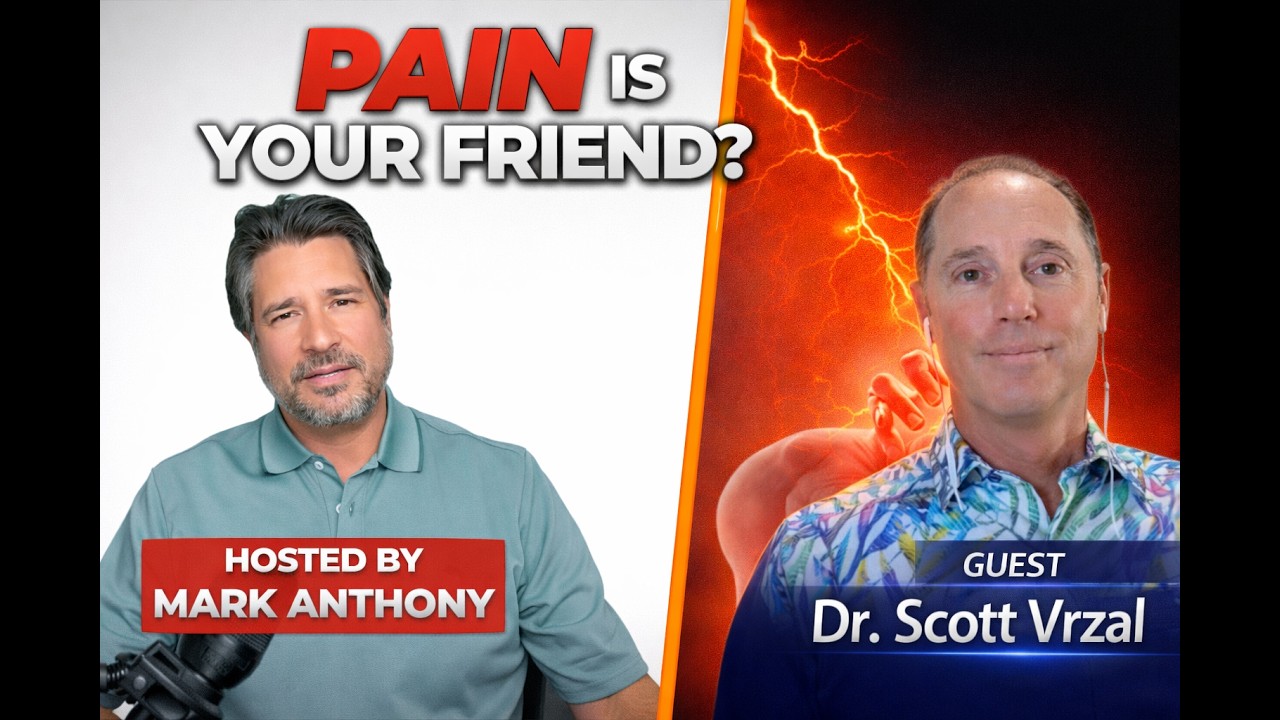
Most people treat a headache as an inconvenience to make go away as fast as possible — reach for a pill, push through, move on. Chiropractor Dr. Scott Vrzal spent this conversation with Mark Anthony arguing the opposite: pain, including head pain, is information. It's the body's way of flagging that something in the lifestyle — usually diet — needs to change, and suppressing the signal instead of reading it tends to let the underlying problem get louder.
Vrzal's interest in headaches didn't start in a classroom. As a teenager training to build muscle, he developed a pounding headache almost every time he did a bench-press session — bad enough that it could last two or three days afterward. Over-the-counter pain relievers didn't help, and pushing through the pain only made the headaches last longer. A full medical workup, including a CT scan with contrast to rule out an aneurysm, came back clear — and at 19 years old, he was told to see a psychiatrist since nothing showed up on the scan. It wasn't until he got his first chiropractic adjustment, at the C2 vertebra, that the whole-head headaches he'd been living with resolved. That experience sent him into chiropractic school and, eventually, into applied kinesiology — the framework he still practices and teaches today, more than three decades later, now based in Southern California.
Key Takeaways
- In Dr. Vrzal's applied-kinesiology framework, headache location is diagnostic: right-side headaches point to the gallbladder, left-side to the stomach, and whole-head "headband" pain to the colon.
- Right-side gallbladder headaches are frequently tied to diet — he named glyphosate residue on wheat, corn, soy, and oats, tomatoes, and trans fats as common triggers, often alongside heartburn, GERD, hiatal hernia, or right knee pain.
- Frequent NSAID or over-the-counter pain-reliever use, he said, can compromise the body's sulfation pathway — the same pathway used to break down cortisol and rebuild connective tissue — potentially prolonging the underlying problem instead of resolving it.
- Vrzal's own weekly, bench-press-triggered headaches at 19 went unexplained through a full medical workup and resolved after a chiropractic adjustment at C2 — the experience that sent him into chiropractic and applied kinesiology.
- He sees patients in his Southern California office and remotely by video, and lays out the full seven-pattern framework in his book, The Headache Advantage.
Why Headache Location Matters: The Seven-Pattern Framework
Vrzal's approach traces back to applied kinesiology, a discipline built on the discovery that specific muscles have associations with specific organs — the same pathways acupuncture meridians run through. Within that framework, he works with seven patterns of head pain, each tied to a different underlying system: gallbladder, stomach, thyroid, colon, pituitary, estrogen metabolism, and a typical stress pattern. His central point is that where a headache shows up matters as much as how bad it is.
The pattern he sees most often in his practice is a right-side headache, which he traces to the gallbladder. He pointed to glyphosate — the herbicide used on much of the wheat, corn, soy, and oats grown in the U.S. to dry crops evenly before harvest — as a common trigger, along with tomatoes and trans fats. Other symptoms he associates with the same right-side pattern include heartburn, GERD, hiatal hernia, and right-side knee pain. On the left side, he pointed to the stomach — describing two cases from his practice, a patient with temporal arteritis (an autoimmune condition) and another with a surgical mesh screen implanted in her skull, where he said correcting the stomach pattern resolved their head pain.
"Organic is cheaper than chemo."
— Dr. Scott VrzalThe Trouble With Relying on Pain Relievers
Vrzal was direct about his concern with leaning on NSAIDs and other over-the-counter pain medications for headaches. In his explanation, these drugs can inhibit a liver pathway called sulfation — the same pathway the body uses to break down cortisol, the stress hormone, and the same one involved in rebuilding tissue with compounds like chondroitin sulfate and glucosamine sulfate. Compromise that pathway, he said, and the body gets stuck in a chronic stress cycle instead of resolving what's actually driving the pain. He also pointed out that patients taking anti-inflammatories for knee pain can inadvertently affect the small intestine, which in turn can keep the knee from tracking properly — perpetuating the very problem the medication was meant to relieve.
His broader advice wasn't to ignore pain, but to treat it as a starting point for investigation — paying attention to how the body responds to specific foods and situations rather than automatically reaching for something to mask the sensation.
Working With Dr. Vrzal: Book, Remote Visits, and Ongoing Education
Vrzal wrote The Headache Advantage as a do-it-yourself resource for readers who want to work through the seven patterns on their own; it's available on Amazon in softcover, hardcover, digital, and audiobook formats. He said he also sees patients remotely by video call in addition to in-person visits at his office, since much of his work involves diet and nutrition guidance that doesn't require an in-person exam. Beyond his own practice, he trains other doctors in applied kinesiology through seminars and hosts a weekly podcast, Truth or Trend: The Holistic Breakdown, covering health topics and trending supplements.
Who This Conversation Is For
If you get frequent headaches and have mostly managed them by reaching for whatever's in the medicine cabinet, this episode offers a different lens — a practitioner's account of using headache location and dietary triggers as diagnostic clues, plus a caution about what long-term reliance on pain relievers can mean for the underlying problem.