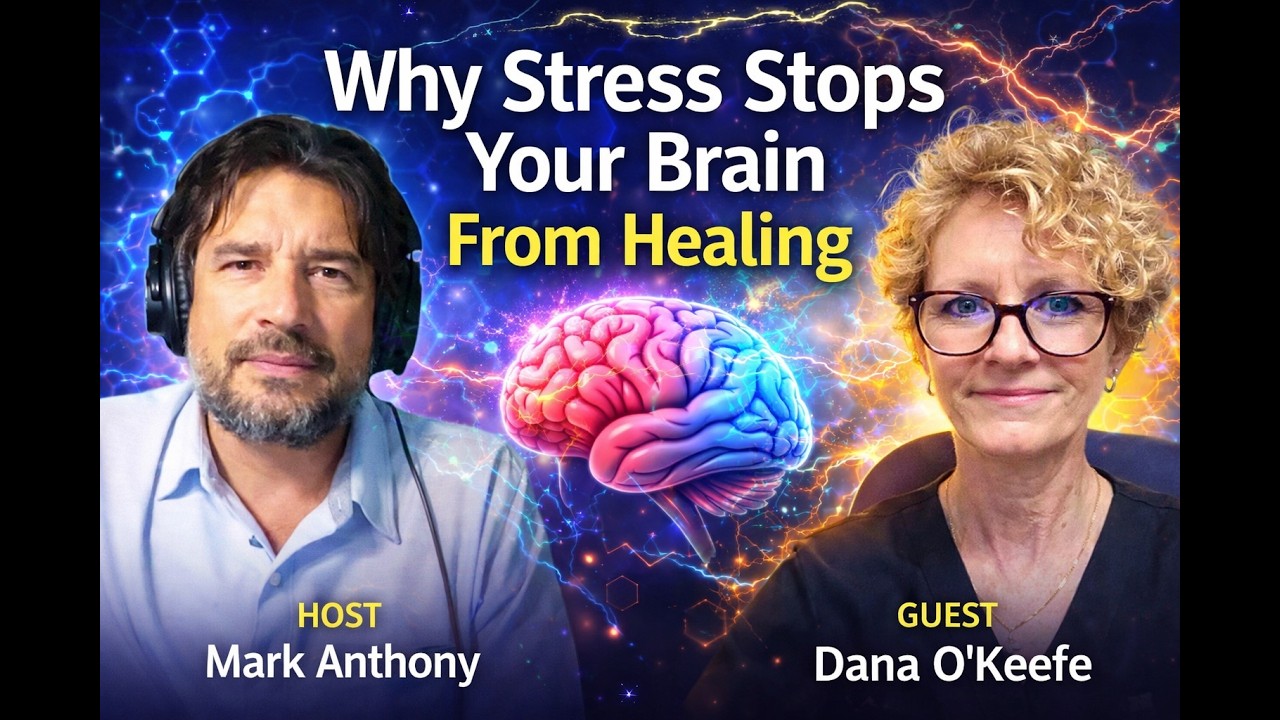
When patients aren't getting better despite eating well, exercising, and trying treatment after treatment, Dr. Dana O'Keefe's first question usually isn't about supplements. It's about the nervous system. In this conversation with Mark Anthony, the chiropractor and functional medicine practitioner walked through a concept she calls "sympathetic overdrive" — a nervous system stuck in fight-or-flight mode — and made the case that until that shifts, real healing is, in her words, physiologically impossible.
O'Keefe practices at Sterling Health & Wellness Center in Maitland, Florida, near Orlando, a practice she said has been open for around 13 years and offers chiropractic care, neurofeedback, and regenerative therapies including PEMF, K-Laser, and shockwave. Her interest in the stress response isn't purely clinical: about four years ago she fractured her back in six places falling off a horse, and when paramedics pricked her finger and found elevated blood sugar, they asked if she was diabetic. She wasn't — her cortisol was so high from the pain and stress that it was pulling glucose into her bloodstream, a firsthand look at exactly the mechanism she now explains to patients.
Key Takeaways
- "Sympathetic overdrive" is Dr. O'Keefe's term for a nervous system stuck in fight-or-flight — and she says real healing can only happen in the parasympathetic ("rest and digest") state.
- The primal, threat-reading part of the brain doesn't distinguish between physical pain, emotional stress, and hidden physiological stress like gut inflammation — it just reads "good" or "bad."
- Heart rate variability (HRV) — the space between heartbeats — is a measurable marker of stress resilience, and can be improved with slow breathing and tracked with wearables like an Aura ring.
- Chiropractic adjustments at C1, the top cervical vertebra, have been studied for their connection to blood pressure via the vagus nerve, which O'Keefe says she sees play out directly in her own husband's care.
- Common physical signs of sympathetic overdrive include fatigue, insomnia, chronic pain, and brain fog — and simple daily habits like morning sunlight, breathing exercises, and limiting screens before bed can help shift the nervous system back toward healing mode.
What "Sympathetic Overdrive" Actually Means
O'Keefe described the body as running on two main nervous systems: the sympathetic, or fight-or-flight, and the parasympathetic, or rest-and-digest. Both exist for good reason — the sympathetic system is built to keep you alive in an acute crisis, not to help you sleep, digest, or heal. The problem, she said, is that the amygdala, the primal part of the brain that reads threat, doesn't distinguish between types of stress. Getting stuck in traffic, a physical injury, or a hidden gut infection the immune system is quietly fighting can all register the same way and keep the nervous system locked in that sympathetic state.
That matters because, in her view, the two states are mutually exclusive when it comes to repair. "You have to be able to at least balance and touch down on the parasympathetic part," she said — and a nervous system that never touches down there doesn't get the chance to actually heal.
"The brain can get stuck in what I call sympathetic overdrive, and it's physiologically impossible for you to heal when you're stuck over here."
— Dr. Dana O'KeefeThe Chiropractic Connection: C1, the Vagus Nerve, and Blood Pressure
O'Keefe pushed back on the idea that chiropractic care is mainly about back and neck pain, framing it instead as nervous-system work. She pointed to chiropractic's own origin story — she described the field's earliest documented case as a patient whose hearing returned after a spinal adjustment, followed by a second early patient whose cardiovascular issue resolved — as evidence the profession was built around the nervous system from the start, not just musculoskeletal pain.
She was more specific about the mechanism at the top of the spine: adjustments at C1, the first cervical vertebra, sit near where the vagus nerve — cranial nerve 10, the body's main parasympathetic pathway — attaches, and she referenced research linking C1 adjustments to lower blood pressure. She made it concrete with an example from her own family: her husband, who has a history of prostate cancer, has vagus nerve damage from radiation treatment, and when his C1 shifts out of alignment he becomes nauseous. She travels with a handheld adjusting tool for exactly that reason.
Measuring Stress and Retraining the Nervous System
O'Keefe pointed to heart rate variability, or HRV, as a practical way to track how well someone's nervous system is handling stress. Rather than beating like a steady metronome, she explained, a healthy heart has small, variable gaps between beats — more space generally reflects a more resilient, adaptable nervous system, and it can be tracked with wearables like an Aura ring. Slow breathing — a longer exhale than inhale — was one tool she pointed to for improving it directly, since exhaling naturally slows the heart rate.
For patients who need more structured support, O'Keefe's practice uses neurofeedback, which she compared to strength training for the brain: just as repeated heavy lifting builds a bigger bicep, a nervous system repeatedly practicing "go-go-go" reactivity trains those patterns in, and neurofeedback works to retrain and rebalance them. Alongside that, she described a handful of low-effort daily habits she recommends for nudging the nervous system toward parasympathetic: sunlight within the first ten minutes of waking without sunglasses, breathing exercises, a downward tummy rub near the diaphragm, singing loudly, and turning phones off after 9 p.m. to cut blue-light exposure before bed. Mark Anthony also shared his own habit of drinking a glass of water every time he uses the restroom to stay ahead of dehydration — which O'Keefe endorsed, adding that the first thing she drinks each morning, before coffee, is 16 ounces of water with added minerals.
Brain Fog, Hormones, and the Gut-Brain Connection
Asked about the brain fog she's seeing more of since COVID, O'Keefe said she works to trace it back to a specific cause for each patient rather than treating it as one condition. In postmenopausal women, declining estrogen is a common driver. In others, she pointed to toxins and heavy metals — she said she has several patients with elevated mercury from silver dental fillings who present with significant anxiety — and to gut inflammation itself, which she summarized as "gut on fire, brain on fire," tying back to the gut-brain connection and the vagus nerve's role in picking up that inflammation.
She also spoke to where she sees her own role fitting alongside AI and online research: a recent patient had already researched her symptoms extensively before her visit, but O'Keefe said the value she adds is synthesizing a detailed intake — her functional medicine intake form runs 38 pages — into a full clinical picture, something she described as requiring human judgment and pattern recognition that goes beyond textbook information.
Who This Conversation Is For
If you or someone you know is dealing with unresolved fatigue, brain fog, insomnia, or chronic pain — especially after trying the usual fixes — this episode offers a plain-language framework for thinking about the nervous system's role in why healing sometimes stalls, along with several low-cost habits Dr. O'Keefe says she recommends to patients as a starting point.