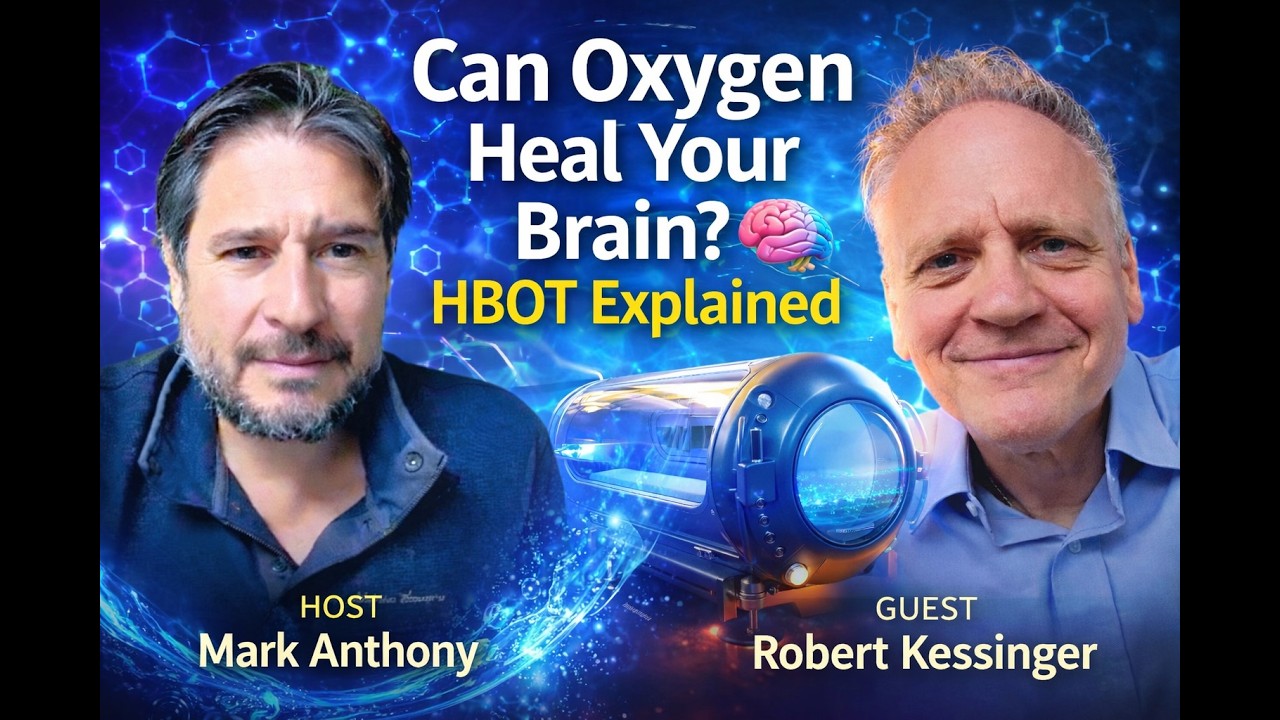
Most people know oxygen as something they breathe without thinking about it. Dr. Rob Kessinger, a fourth-generation chiropractor who has worked with hyperbaric oxygen therapy for nearly twenty years, spent this conversation with Mark Anthony making the case that how oxygen gets into the body — not just how much of it a person breathes — is the real story behind HBOT, and why it shows up everywhere from stroke recovery to long-COVID care to pre-surgical prep.
Kessinger's family has practiced chiropractic for more than a century — his great-grandfather graduated in the 1920s, his grandfather in 1948, his father in 1963. He spent his first fifteen to twenty years in practice focused on upper cervical chiropractic before earning a board certification as a "chiropractic internist," a credential in natural and functional medicine that he now helps teach to other practitioners. His own introduction to HBOT, though, started as a patient rather than a provider: in 2007 he was diagnosed with sarcoidosis that affected both his lungs and his spinal cord, and hyperbaric oxygen became part of his own recovery. He's used it in his practice ever since — by his own estimate, in the hundreds of sessions.
Key Takeaways
- HBOT works through pressure, not just oxygen percentage: at up to two atmospheres, two physics principles (Boyle's Law and Henry's Law) let oxygen convert into a free-floating liquid state that can bypass red blood cells and reach oxygen-starved tissue directly.
- Dr. Kessinger's clinic uses roughly 93% oxygen, not 100%, largely for safety and regulatory reasons, delivered while patients sit in a pressurized chamber for about an hour to ninety minutes.
- He groups the conditions he sees respond well into three "baskets": brain-based issues (stroke, TBI, mild cognitive impairment, autism), chronic infections (Lyme, long COVID, Epstein-Barr, fibromyalgia), and general health and longevity — plus pre- and post-surgical recovery.
- The rebound drop in oxygen after a session activates HIF (hypoxia-inducible factor) genes — the subject of a Nobel Prize in Medicine — which Kessinger says triggers stem cell release, new blood vessel growth, and mitochondrial repair.
- His own path into HBOT started as a patient: a 2007 sarcoidosis diagnosis affected his spinal cord, and hyperbaric oxygen became part of his own rehabilitation before it became part of his practice.
What Hyperbaric Oxygen Therapy Actually Does to the Body
Air at sea level is a little under 21% oxygen. Normally, that oxygen has to hitch a ride on red blood cells to get anywhere in the body, funneling through progressively smaller vessels until it reaches what's called a capillary bed — the tissue-level exchange point where oxygen is actually delivered. Only one red blood cell can pass through a capillary at a time. After an injury like a stroke or traumatic brain injury, swelling around the site compresses those capillary beds, and the surrounding tissue — starved of the oxygen it needs to repair itself — can end up in what Kessinger described as a dormant state: alive, but not functioning.
Pressure is what changes that equation, he explained. His clinic brings patients up to as much as two atmospheres inside the chamber — roughly the equivalent of being 33 feet underwater — over about 10 to 15 minutes, similar to the ear-popping sensation of a descending airplane. Two centuries-old physics principles do the actual work: Boyle's Law, which says gases shrink under pressure, and Henry's Law, which says gases can convert into liquid under pressure. Under that pressure, the oxygen a patient breathes — his clinic uses about 93% oxygen rather than 100%, for safety and regulatory reasons — converts into a free-floating liquid state that no longer needs a red blood cell to travel. That lets it reach oxygen-starved tissue directly, bypassing the compressed capillary bed altogether.
Despite how it sounds, Kessinger said most patients — including people who consider themselves claustrophobic — find a well-designed chamber more comfortable than expected, largely because of how much glass is used in the build. Once a patient reaches full pressure, he said, they typically don't feel it at all; a full session runs about an hour to an hour and a half. The field's terminology traces back to an unlikely source: the first hyperbaric chamber dates to the 1600s, built by a clergyman using organ pipes long before oxygen itself was understood, but the therapy's popularization — and the term "dive" — came from the U.S. Navy, which used pressurized chambers to treat divers with decompression sickness by converting nitrogen gas bubbles in the blood back into liquid.
Kessinger also drew a distinction between HBOT and two other oxygen- and circulation-related tools that came up in the conversation: exercise-with-oxygen training, done on a stationary bike with an oxygen mask, which he said hyper-saturates red blood cells during exertion; and a PEMF-style device sometimes called "the Beamer," which he described as changing the electrical charge of red blood cells so they stop clumping together and exchange oxygen more efficiently at the capillary level. Both, he said, are worthwhile tools — but neither produces the free-floating, liquid-state oxygen that only pressure can create.
The Three "Baskets" of Patients Dr. Kessinger Sees Respond Well
Asked which conditions tend to respond best, Kessinger organized his answer into what he called three baskets, drawn from his own clinical experience:
- Brain-based conditions: stroke, traumatic brain injury (including mild TBI), early-onset dementia, mild cognitive impairment, and autism. Kessinger said the common thread is that HBOT super-saturates the brain with oxygen, giving it the energy it needs to repair itself.
- Chronic infection and related syndromes: Lyme disease, long COVID, Epstein-Barr, chronic fatigue syndrome, and fibromyalgia. He pointed to hypercoagulation — a tendency for blood to clot or thicken abnormally — as a common thread running through many long-COVID cases in particular.
- General health, wellness, and longevity — a broader, preventive use of the therapy separate from treating a specific diagnosis.
He also described an offshoot use: two or three sessions before a scheduled dental procedure or joint replacement, followed by a few more afterward, which he said the literature supports as a way to meaningfully shorten recovery time. Separately, he mentioned early clinical interest in using HBOT for conditions like glaucoma, though he was clear that this application is much newer and far less established than the brain-based and infection-related uses above.
"Oxygen is what makes life work. All life revolves around oxygen. The better you're able to utilize oxygen in your body, the longer you live, and the less chance you're going to have for sickness and disease."
— Dr. Rob KessingerThe Nobel Prize Science Behind the "Rebound" Effect
The mechanism Kessinger returned to repeatedly ties back to a discovery that won its researchers a Nobel Prize in Medicine: the body's genetic response to hypoxia, or low oxygen. During a session, he said, the body's free-floating oxygen level can rise dramatically — he cited figures as high as roughly 400 times normal, while noting the exact multiple varies by study. When the session ends and that level drops back down, the sudden shift activates what are known as HIF genes, or hypoxia-inducible factor genes.
According to Kessinger, that activation triggers several downstream effects: release of the body's own stem cells; production of VEGF (vascular endothelial growth factor), which builds new blood vessels and improves circulation; and a reduction in reactive oxygen species that helps protect mitochondria, the cell's energy-producing structures. He connected this to a process called mitophagy, in which damaged mitochondria break down and rebuild themselves — a process he linked directly to fatigue when it isn't functioning well. It's this rebound effect, he said, more than the oxygen itself, that he believes explains HBOT's growing reputation in longevity medicine.
What a Course of Treatment Looks Like: Protocol, Cost, and Risks
For conditions like stroke, traumatic brain injury, or Lyme disease, Kessinger's general recommendation is at least three sessions a week for the first month — sometimes two months for more complex cases — because that frequency is what allows the HIF-driven rebound effect to compound. Daily sessions are even better, he said, while going less than three times a week may produce a short-term lift in how a patient feels without the longer-term benefit. After that initial block, most patients can taper to a maintenance schedule — weekly, every other week, or monthly "tune-ups." He also described a useful early signal: if a patient notices even a mild positive response after their first one to three sessions — more energy, clearer thinking, less pain — that tends to predict a longer series will produce more lasting results. Diabetic ulcers, he said, typically take five to seven sessions before visible healing begins.
Kessinger shared two specific examples from his own practice. One was a man in his 60s who came in for an unrelated issue and reported, unprompted, that he'd stopped waking up multiple times a night to urinate — a change Kessinger could only attribute to the HBOT sessions, though he framed it as an unplanned observation rather than a proven indication. The other involved stroke patients with functional loss dating back five or more years who, in some cases, regained a meaningful — though not complete — degree of function after treatment. He linked this to something brain surgeons have described as the "penumbra effect": tissue near an injury site that isn't dead but is dormant, receiving just enough oxygen and glucose to survive without thriving, and capable of reactivating years later if blood flow improves. He was direct that this doesn't happen in every case, and that he doesn't "promise the moon" to patients.
On cost, Kessinger said pricing varies significantly by location, but at the time of the conversation he put a typical single session somewhere in the $90 to $150 range, with clinics commonly offering discounted multi-session packages. On risk, he said the limiting factor for most patients is ear-pressure equalization — similar to the discomfort some people feel on an airplane — rather than any broader side-effect profile. He's cautious about hyperbaric treatment for pregnant patients, even though he noted the literature supports its use in specific circumstances, and he avoids treating anyone with an active inner-ear infection.
If you're navigating stroke recovery, long COVID, or simply curious what's inside those pressurized chambers now showing up in gyms and wellness centers, this episode is a plain-language primer from someone who has spent nearly two decades as both patient and practitioner.