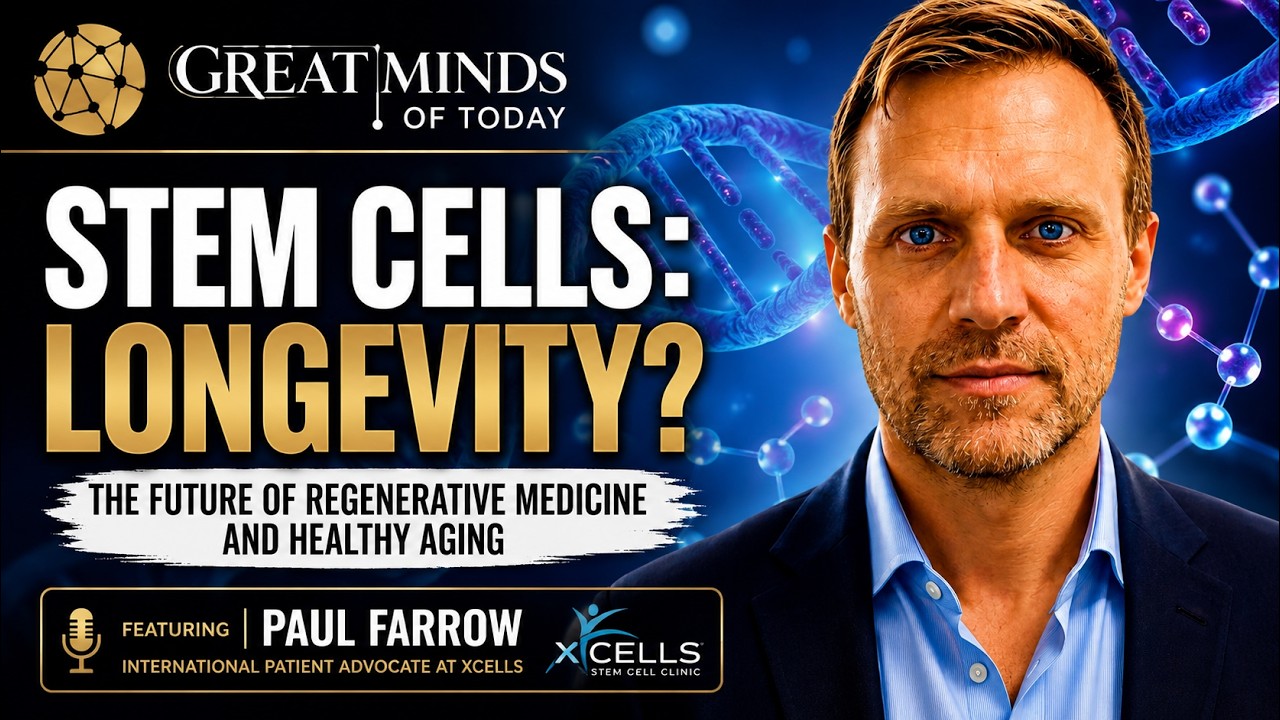
Paul Farrow is the International Patient Advocate at XCells, a regenerative medicine clinic based in El Poblado, Medellín, Colombia, with additional locations in Panama City and Barbados. Originally from the UK, he found his way into the field after his own experience as an amateur boxer left him with a chronic shoulder injury — and became convinced enough by his own recovery to spend years learning the science and building relationships across the international stem cell industry before joining XCells full-time.
A note on this page: Paul is a patient advocate at a commercial clinic, not a physician, and XCells is a business marketing paid treatments — many using donor-derived cells not approved for this use in the US. What follows reflects his own explanations and the clinic's own published claims, not independently verified medical consensus. Treat it accordingly.
Key Takeaways
- XCells primarily uses donor-derived mesenchymal stem cells from umbilical cord tissue (Wharton's jelly), distinct from autologous cells harvested from a patient's own fat or bone marrow.
- The clinic uses "hypoxic" cells — expanded in a low-oxygen lab environment — which Paul Farrow says makes them more resilient once injected into low-oxygen joint environments.
- Screening matters: Paul was direct that active cancer patients and patients with no remaining cartilage in a joint are not candidates for stem cell treatment.
- A knee treatment package at XCells runs roughly $2,500, versus $7,500–$8,500 he and host Mark Anthony discussed as typical in the US — not including travel.
- His own advice on choosing a clinic: check how cells are sourced and processed — he specifically warned about bovine-derived expansion media and potency loss from repeated freeze-thaw cycles.
- XCells reports ISO 9001:2015 and GMP certification, ISSCR membership, and Colombian Medical Association accreditation — its own published credentials.
From the Boxing Ring to Regenerative Medicine
Paul Farrow's path into regenerative medicine started with an injury, not a business plan. Years of amateur boxing for fitness left him with chronic shoulder inflammation — an MRI showed no actual tears, but he couldn't lift his arm. After researching alternatives, he tried a stem cell clinic: an IV plus an injection directly into the shoulder. "Within a week I was doing push-ups," he said. "The penny dropped."
When COVID hit and interest in immune health spiked, he enrolled in a distance-learning master's program in stem cell biology and regenerative medicine through Bristol University — he didn't complete it, but said the coursework, combined with meeting practitioners across the Middle East and the US, is what pulled him fully into the field. One relationship he pointed to specifically: Bob Harman, a veterinarian in the San Diego area and, in Paul's words, a pioneer of autologous (patient's-own-cell) veterinary stem cell therapy, whose work has included treating exotic and endangered animals.
"There's an alternative to surgery, anti-inflammatory pills, cortisone shots, and steroids — all this stuff they push on you in Western medicine."
— Paul FarrowAutologous vs. Donor-Derived Stem Cells
Paul drew a clear line between the two main sources of mesenchymal stem cells used in regenerative medicine. Autologous cells come from a patient's own body — typically harvested from adipose (fat) tissue via a minor liposuction procedure, or from bone marrow. Donor-derived cells, which is what XCells primarily works with, come from umbilical cord tissue donated after birth, specifically harvested from Wharton's jelly.
Each has tradeoffs, in his framing: autologous treatment requires an extraction procedure but uses a patient's own genetic material, which some people are simply more comfortable with. Donor-derived treatment skips the extraction, but means receiving another person's cells — something he said some patients weigh carefully before deciding.
How Systemic Stem Cell Therapy Is Supposed to Work
When mesenchymal stem cells are delivered intravenously, Paul explained, they circulate throughout the body rather than staying localized to one injection site. His description: the cells are drawn toward signals of oxidative stress, inflammation, and cellular damage, where they release growth factors and exosomes intended to calm inflammation and support the body's own repair processes — rather than becoming new tissue themselves. He was careful to frame this as something that shouldn't be overdone, recommending treatment no more than once every six months, ideally closer to once a year, to avoid overtaxing the body.
Hypoxic Cells: XCells' Point of Difference
A specific technique Paul highlighted: expanding stem cells in a hypoxic (low-oxygen, roughly 2–3%) lab environment rather than standard atmospheric conditions. He credited the Cellular Performance Institute (CPI) in Tijuana — which he noted works with UFC athletes — as a pioneer of the approach, and said XCells has adopted the same hypoxic expansion process. His reasoning: joints like the knee or shoulder are naturally low-oxygen, low-blood-flow environments, so cells already adapted to thrive with less oxygen tend to survive and remain active longer once injected there. He offered one example from his own clinic — a sports agent client with a meniscus injury who, he said, went from barely able to walk to pain-free within 24 to 48 hours of treatment, which he was clear is an unusually fast result, not a typical timeline.
Who XCells Turns Away
Paul was direct about who shouldn't receive treatment. Patients with active cancer are screened out entirely — the same growth factors that help healthy tissue repair could, in theory, help a tumor grow, which he called a hard ethical line. Patients who are completely bone-on-bone in a joint, with no cartilage left at all, are also told treatment won't help, since there's no remaining tissue to support.
He also described turning away patients who won't engage with root-cause work — describing one prospective patient, a wealthy client with an autoimmune condition tied to gut health, who declined to complete a requested stool sample and follow-up evaluation and went elsewhere instead. "I said, okay — because you're not gonna get the results with us," he said.
Treating Spine and Disc Pain
XCells' spine and pain-management work, Paul said, is led by team members with backgrounds in anesthesiology and pain management for the cervical and lumbar spine — a discipline traditionally treated with cortisone or steroid injections. His description of the alternative approach: injecting fresh, non-cryopreserved hypoxic cells into a compromised disc to support regeneration, which can relieve pressure on nearby nerves, and separately treating the facet joints and epidural spaces where nerve irritation often originates. He described this as one of the areas where he sees the most patients seeking relief from chronic back and radiating leg or arm pain.
A Patient's Story: Kimberly's Lupus Remission
Paul shared the story of a patient — he calls her Kimberly — who came to XCells with lupus and, following treatment, saw her disease markers return to zero. She has since become an outspoken advocate for the clinic: she has her own podcast, has written about the emotional dimensions of autoimmune illness (in her case, tracing some of it back to unresolved guilt), and — Paul noted, with evident pride — is now in her 60s and still surfing regularly in Panama. He was clear that outcomes like hers depend heavily on a patient's own willingness to change diet and lifestyle alongside treatment, not on the injections alone.
"If you're not going to do the work and get to the root cause of the problem, you're only gonna get a limited response."
— Paul FarrowWhat It Costs, and What's Included
Paul cited specific numbers on the podcast: a knee treatment combining hypoxic stem cells with an IV of exosomes runs roughly $2,500 through XCells, compared to the $7,500–$8,500 he and Mark Anthony discussed as a typical US price for a comparable treatment. That figure covers the treatment itself, not flights or hotels — though he said the clinic helps arrange airport pickup and hotel recommendations across a range of budgets. His stated philosophy: "We don't price gouge... we offer really the best value for money, the top quality cells... and the best guidance," positioning affordability as a way to treat more patients rather than a signal of lower quality.
What to Check Before Choosing a Clinic Abroad
Paul offered pointed, specific advice for evaluating any stem cell clinic, XCells included. Two concerns he raised directly:
- Sourcing and expansion media: he said some clinics, particularly in Mexico, use bovine (cow-derived) media to expand human cells in culture — raising, in his view, a real cross-contamination risk worth asking about directly.
- Freeze-thaw potency loss: cryopreserved cells require preservatives he described as toxic, and lose measurable potency — what he called "bioavailability" — with each freeze-thaw cycle. He recommended asking whether cells are used fresh and washed, rather than frozen and reanimated on-site.
He also pointed to formal certifications as a baseline filter: ISO 9001 quality management, GMP (Good Manufacturing Practice) compliance, and adherence to FDA guidelines for cord blood handling, even at clinics operating outside the US.
Where Paul Sees Regenerative Medicine Headed
Looking ahead, Paul pointed to two converging trends: AI-driven "digital twin" health monitoring — using wearables and continuous data to predict and prevent illness before symptoms appear — and research into programming stem cells for specific regenerative functions, such as restoring pancreatic function in diabetes. He referenced longevity researcher David Sinclair's published work on genetic factors tied to aging as an example of the broader science moving in that direction. "Prevention's the best cure, always," he said.
About XCells & the Medical Team
Per XCells' own published information, its clinical team includes:
- Dr. José Carlos Osorio Campo — Orthopedic Surgeon, MD in Orthopedic & Trauma Surgery, 15+ years in regenerative therapies (stem cells, exosomes, PRP) and reconstructive orthopedic surgery
- Dr. Álvaro Ospina — Anesthesiologist, 15+ years in pain management and spine treatment using stem cells
- Dr. Jorge Andres Quiceno Vasquez — Functional Medicine physician (MD 2019), trained in stem cells and regenerative medicine
- Dr. Carlos Tavera — Plastic Surgeon, MD from University of Antioquia, 12+ years in facial rejuvenation and reconstructive procedures
- Katherine Ochoa Muñoz — Medical Coordinator, 15+ years coordinating medical and surgical operations
- Mairelena Sebastiani — Holistic Nutritionist, functional nutrition guidance
- Paul Farrow — International Patient Advocate, English-language support and travel coordination
XCells reports ISO 9001:2015 quality management certification, Good Manufacturing Practice (GMP) compliance, membership in the International Society for Stem Cell Research (ISSCR), and Colombian Medical Association accreditation. The clinic states it has treated 1,000+ patients from 50+ countries. These are the clinic's own published figures.
- Location: Cl. 7 #39-107, El Poblado, Floor 7, Suite 714, Medellín, Colombia — with additional locations in Panama City and Barbados
- Hours: Monday–Friday, 8:00am–6:00pm
- Contact: (305) 504-7175 · info@xcells.com
Learn more: xcells.com · About Paul & the XCells team · Plan Your Visit