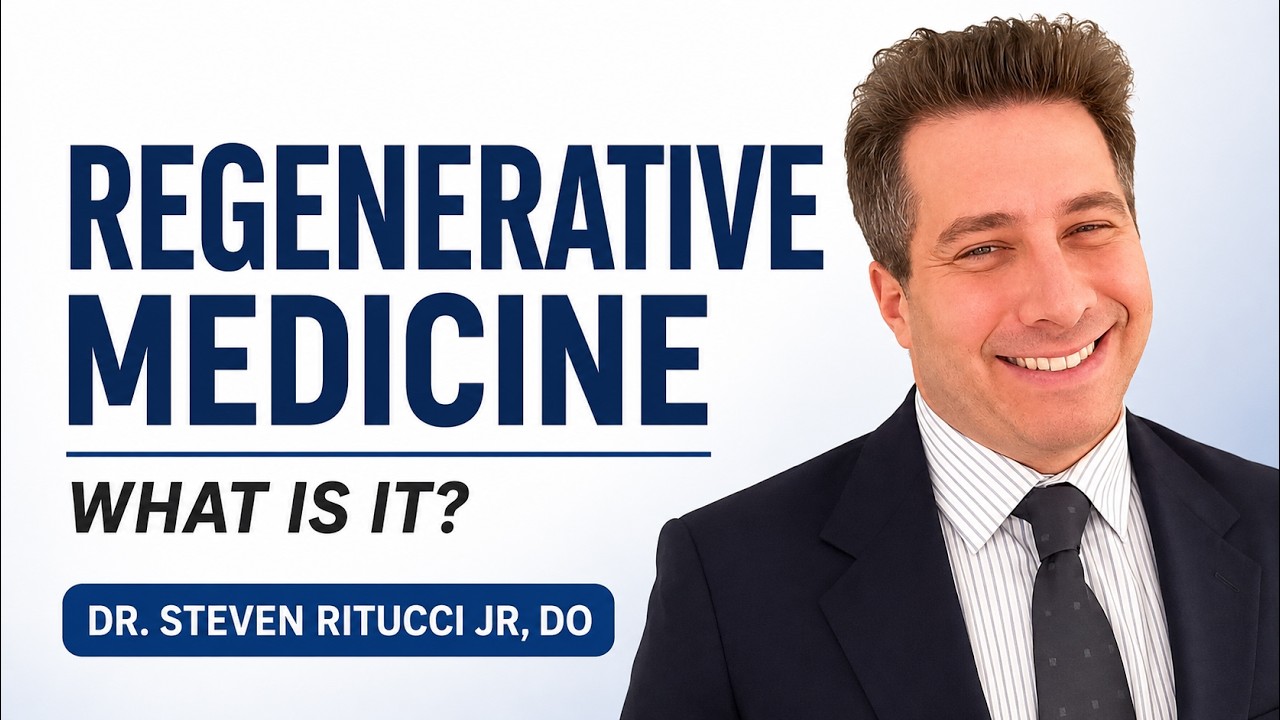
Most people hear "regenerative medicine" and picture something experimental or fringe. Dr. Steven Ritucci Jr., DO — a physiatrist who has spent 16 of his 25 years in practice focused specifically on it — spent this conversation with Mark Anthony making the opposite case: it's a set of specific, non-surgical tools with a specific job, and the job is helping the body heal tissue it hasn't been able to heal on its own.
Ritucci's own path into the field started as a patient, not a prescriber. A former national-level powerlifter in college, he went through his own run of injuries, physical therapy, and chiropractic care before an exercise-science degree turned into medical school specifically so he could go deeper into "nutrition and science and chemistry." He's a DO — trained in osteopathic manipulative treatment alongside conventional medicine — and today runs Ritucci Regenerative Medicine in Norwood, Massachusetts, after cutting his teeth doing high-volume bone marrow aspiration procedures at QC Kinetics earlier in his career.
Key Takeaways
- Regenerative medicine is an umbrella term covering PRP, bone marrow-derived stem cell therapy, and shockwave — three distinct tools, not one treatment.
- Focused shockwave penetrates deep into joints via mechanotransduction and angiogenesis; radial shockwave is more superficial and better suited to broad myofascial pain.
- PRP concentrates a patient's own platelets to block inflammatory cytokines like interleukin-1 and TNF-alpha — it's shown to outperform cortisone even in severe (Kellgren-Lawrence grade 4) knee arthritis.
- Bone marrow-derived stem cells go a step further than PRP, with more capacity to contribute directly to cartilage, tendon, and ligament regeneration.
- Dr. Ritucci described patients who postponed or canceled scheduled hip and shoulder replacement surgery after a course of treatment — though he was direct that surgery is still the right call in some cases.
PRP, Bone Marrow Stem Cells, and Shockwave — What Each One Actually Does
Ritucci walked through all three tools he uses, and was specific about what separates them:
- PRP (platelet-rich plasma): a patient's blood is drawn and spun down to isolate platelets, which are then injected into the injured joint. PRP helps activate whatever dormant stem cells are already present locally, and — separately — blocks the inflammatory cytokines that drive both pain and the ongoing arthritic process.
- Bone marrow-derived stem cells: cells are aspirated from the back of the pelvis under local anesthetic, concentrated in a centrifuge, and injected into the joint. Ritucci described this as having "a lot more ability to actually release a lot more stem cells in the area" and a greater shot at real cartilage, tendon, and ligament regeneration — not just pain relief.
- Focused shockwave: an electromagnetic device produces a physical shockwave that penetrates deep into a joint or tendon, triggering mechanotransduction — essentially pressing a cell's regenerative "buttons" through physical force rather than a chemical signal — and encouraging angiogenesis, new blood vessel growth, to help the area heal itself. Ritucci uses shockwave on his own chronic back and shoulder issues.
"What have you got to lose? If the insurance-based treatments are failing you, what are you going to get — more insurance-based treatments?"
— Dr. Steven Ritucci Jr., DOReal Patient Outcomes Discussed in the Episode
Ritucci described several specific cases from his own practice: a 68-year-old patient scheduled for hip replacement who, after a combination of PRP and bone marrow stem cell treatment, canceled the surgery and went on to travel internationally with his fiancée. A second patient scheduled for rotator cuff repair tried PRP, an A2M injection, and a bone marrow procedure on the shoulder instead — and at the one-year mark was, in Ritucci's words, "still doing great." He also referenced a patient in his late 60s now running three miles regularly after being unable to walk comfortably when he first came in.
He was careful to frame this as case-specific, not universal — patients who are bone-on-bone across every compartment of a joint are less likely to see tissue regeneration, though PRP can sometimes still help manage pain in those cases. Surgery, he said plainly, is still the right call when it's warranted.
Cost, Access, and Where the Field Is Headed
Regenerative treatments are largely cash-pay rather than insurance-covered, though Ritucci noted the VA has begun covering PRP in some cases, and he expects the category to keep moving toward the mainstream as more long-term outcome data accumulates. He was candid about the tradeoff patients are weighing: surgery carries real costs of its own, both financial and in recovery time away from work and daily life, which is part of why he sees regenerative options as worth exploring earlier for patients in that "gray zone" between conventional treatment and surgery.
He also touched on newer, less-regulated sources like umbilical cord and Wharton's jelly-derived cells as a developing option for older patients whose own bone marrow may be compromised by prior radiation or other issues — an area he expects the FDA to continue shaping over the next several years.
Who This Conversation Is For
If you're dealing with a chronic joint, tendon, or ligament issue and have been told surgery is your only option — or you're simply "waiting it out" — this episode is a useful primer on what the non-surgical alternatives actually involve, in plain language, from someone who is both a practitioner and a longtime patient of his own field.