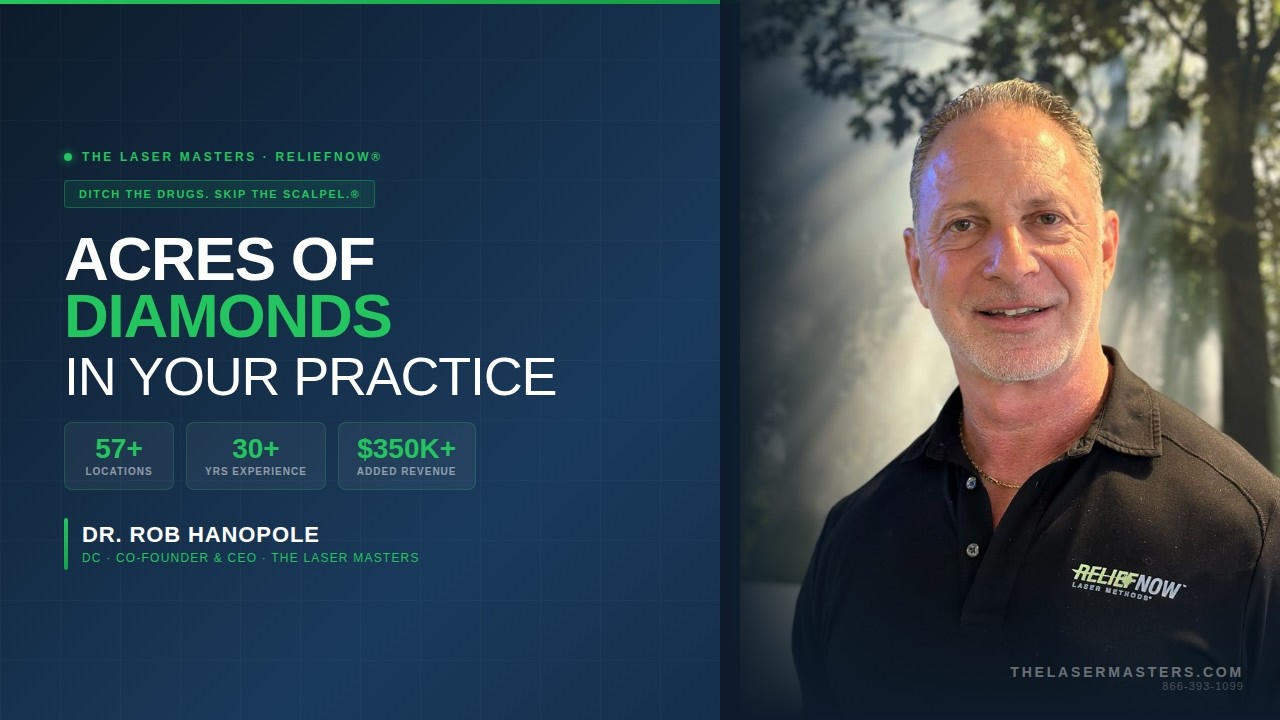
Dr. Robert Hanopole, DC has spent 31 years in chiropractic practice, most of it built around a main office in South Florida — but his conversation with Mark Anthony wasn't really about adjustments. It was about what he calls "acres of diamonds": the untapped revenue he believes is already sitting inside a chiropractor's existing four walls, waiting to be developed, rather than searched for somewhere else entirely.
Hanopole is Co-Founder & CEO of The Laser Masters and ReliefNow™ Laser Centers, the practice-within-a-practice model he built after years of using lower-powered lasers — including as part of a General Motors-sponsored study on carpal tunnel patients with more than 2,000 participants — before moving up to Class IV lasers and eventually turning what started as, in his words, "a piece of equipment in a chiropractic office" into its own branded business line. Today ReliefNow has roughly 60-plus licensed locations across the U.S., a location in Dubai, and interest in opening one in Puerto Rico; the network's chief medical officer is Dr. Manish Gupta, a board-certified orthopedic surgeon.
Key Takeaways
- Hanopole's "Acres of Diamonds" philosophy argues that most of a chiropractic practice's growth opportunity is already sitting inside it — underused equipment, an existing patient base — rather than requiring an entirely new business.
- Only about 10% of the population will ever see a chiropractor, in Hanopole's telling, which is why ReliefNow Laser Centers are branded and marketed separately from the host chiropractic practice.
- Class IV lasers are defined as 500 milliwatts of power or more; different wavelengths (810nm, 915nm, 980nm, 1064nm) penetrate and absorb differently, and treatment dose is measured in joules, delivered across a course of visits much like a prescribed medication.
- The ReliefNow model is deliberately private-pay rather than insurance-billed, which Hanopole ties to how laser and regenerative-style care are classified under Medicare guidance.
- Hanopole described specific practice examples from his network — including a solo practitioner who went from roughly $60,000–$65,000 a month to about $200,000 a month after adding a laser center — while framing these as individual cases, not guaranteed outcomes.
Acres of Diamonds: Building a Second Practice Inside the First
Hanopole traces the "Acres of Diamonds" concept to a book he credited to author Catherine Ponder — the idea that opportunity is usually sitting inside what a business already has, not somewhere else that looks greener. Applied to chiropractic, he said the real obstacle most practices face isn't ability, it's perception: only about 10% of the population will ever visit a chiropractor, even though he believes chiropractic could help far more people, because of lingering misinformation and the profession's distance from hospital and physician referral networks.
His fix was to build a second, separately branded business — a ReliefNow Laser Center — inside the same office, sharing the same overhead. He compared it to Dunkin' Donuts and Baskin-Robbins sharing a building: two identities, two customer bases, one roof. Patients who'd never book a "chiropractor" appointment for a shoulder or elbow problem — because, in his words, when a chiropractor mentions treating a knee, "it almost seemed like the patient was hearing something different, almost like a foreign film" — will book a laser appointment for the same joint without hesitation. Some ReliefNow patients, he said, have driven several hours or flown in from the Bahamas, Jamaica, and Haiti specifically for laser care, occasionally asking about seeing their own chiropractor only after the laser visit.
"Is your laser collecting dust, or is your laser collecting cash?"
— Dr. Robert Hanopole, DCInside Class IV Medical Laser Therapy
Hanopole walked through the technical side of what his network standardizes as "Medical Laser Therapy," or MLT — a term he said was created to cut through a confusing field of overlapping marketing labels like cold laser, hot laser, and low-level laser. Any device producing 500 milliwatts of power or more is classified as Class IV, he explained, and different wavelengths behave differently in tissue: 810 nanometers is, in his words, "the jack of all trades," the most broadly absorbable wavelength; 915 and 980 nanometers generate more heat at higher settings; and 1064 nanometers penetrates deepest but is the least absorbable of the group.
Dosing, he said, is measured in joules of energy rather than milligrams — he compared it to spreading a course of antibiotics across ten days instead of taking the full amount at once. A given course might call for 60,000 joules delivered across ten visits, for example; going over the tissue's capacity per visit wastes time without adding benefit, since once the cells absorb what they can use, "the picture's full at that point." He also noted that a Class IV device can deliver a therapeutic dose in five to seven minutes, where a lower-powered device might take an hour or more to reach the same total energy. Every new patient goes through a consultation and exam first, and Hanopole described contraindications as few — mainly avoiding treatment directly over electrical implants or known cancerous tumors — calling laser, in his assessment, very safe.
A Patient Story: Nine Treatments, No Amputation
Hanopole described a new patient, a nurse named Karen, who arrived at his office in tears — not from physical pain, she told him, but because she'd just been told she needed two toes amputated due to diabetic ulcers, and had heard laser therapy might help. He said he was careful not to overpromise: there are, in his words, "limitations of matter," and some tissue damage can't be reversed. She chose to try it anyway. After nine treatments, he said the ulcers were completely healed — a result he described as visible proof, on the surface of the skin, of a healing process he normally can't see happening deep inside a joint or tendon.
"Nobody wants to lose any kind of body parts. I understand, and that's why I'm willing to try and help you, but I just don't want to give you false hope."
— Dr. Robert Hanopole, DCWhy the Model Stays Cash-Pay — and What It Did for Practice Revenue
Hanopole was direct that ReliefNow deliberately avoids billing insurance for laser care, positioning it instead as a regenerative-medicine service patients pay for directly. He said that's partly a matter of classification — he paraphrased Medicare guidance as excluding services aimed at preventing disease, promoting health, or enhancing quality of life from being considered "medically necessary" — and partly a matter of control, since once insurance is involved, a practice has to play by its rules. He also pointed to the existence of an ICD-10 diagnostic code for "Failed Back Surgery Syndrome" (FBSS) as evidence that conventional, insurance-covered care doesn't always deliver either.
On the business side, Hanopole described specific examples from doctors in his network: one solo chiropractor he said had been running roughly $60,000–$65,000 a month before adding a ReliefNow Laser Center was, at the time of the conversation, doing about $200,000 a month. Another doctor, whose practice had been built entirely around personal injury and workers' compensation cases, added roughly $70,000-plus a month in private-pay laser revenue after bolting on the model. Hanopole framed both as specific practice examples rather than typical or guaranteed results.
He also described the "Ditch the Drugs, Skip the Scalpel®" ethos that runs through the brand, including a challenge coin doctors in the network carry, and mentioned an in-development "Ditch the Drugs and Skip the Scalpel Foundation" intended to support people affected by adverse drug reactions — referencing a statistic he cited from a few years back of roughly 128,000 annual U.S. deaths tied to properly prescribed medication.