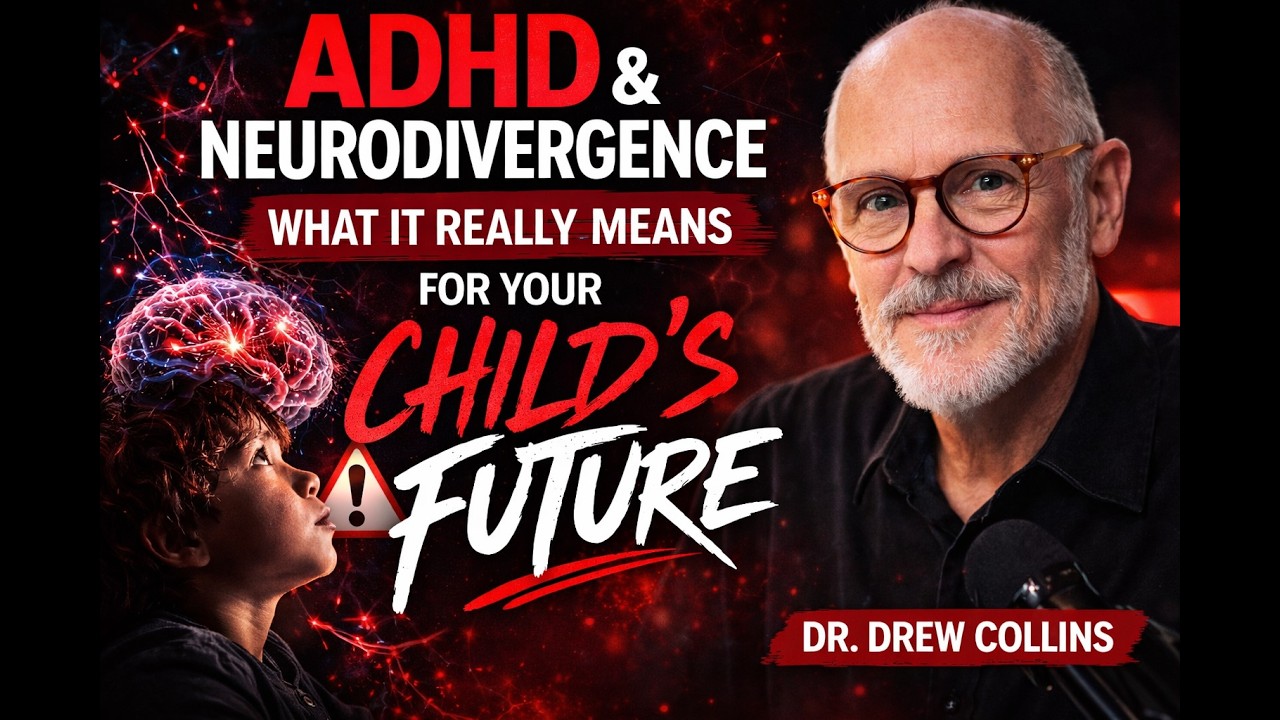
Ask why ADHD diagnoses keep climbing and most people land on one of two answers: either we're finally getting better at recognizing it, or too many kids and now adults are being handed a label and a prescription for what used to just be personality. Naturopathic doctor Dr. Drew Collins of Proactive Choice, a returning guest on Great Minds of Today in an ongoing series with host Mark Anthony, argues both things are happening at once — and that the diagnostic system itself, not just the underlying biology, is shaping who gets labeled and how they get treated.
Collins practices as a cash-pay naturopathic doctor working alongside, not against, conventional psychiatric care. His particular interest is in genetic and methylation testing as a lab-based complement to the purely observational diagnostic process behind ADHD, autism, anxiety, and depression — and in the lower-cost, non-pharmaceutical supports he believes are being stripped out of schools just as diagnosis rates are rising.
Key Takeaways
- Collins argues the explosion in ADHD and related diagnoses is tied partly to how DSM-5 diagnostic codes work — a specific code is what makes a specific drug insurance-reimbursable — not necessarily to better understanding of the underlying condition.
- Adult ADHD is a newly emphasized diagnostic category, and Collins says women and girls have historically been under-represented in the research behind these criteria, since symptoms in girls often present as quiet inattentiveness rather than disruptive hyperactivity.
- He uses a cheek swab or blood test to screen for genetic markers (SNPs) tied to methylation, which he estimates are mutated in 40 to 50% of the population — and says certain variants can predict why some kids react badly to stimulant medication.
- Collins isn't opposed to medication and calls stimulants one of the clearer success stories in modern pharmacology for managing behavior, but he's concerned that long-term use can down-regulate the brain's own neurotransmitter receptors, similar to a dependency pattern.
- His practical, lower-cost recommendations — especially for kids — center on exercise, consistent sleep, nutrition, and school enrichment like art, music, and pet therapy.
Why ADHD Diagnoses Are Exploding — And Why That's Not the Same as "More Understood"
Collins framed the conversation with what he called the "artist's dilemma" or "inconvenient genius" — the idea that people who think differently aren't a new phenomenon, but a sociological and demographic one layered on top of a biological one. Families under modern economic stress, more households where both parents (or a single parent) work, and diagnostic criteria that have grown more elaborate with each edition of the DSM, from DSM-1 through DSM-5, have all combined to widen who ends up with a diagnosis code. Adult ADHD — what Collins called "adult hyperactive disorder" — is a relatively new focus in academic psychiatry, and he pointed out that women have historically been under-studied in this research, since many girls present as quiet and inward rather than disruptive, and aren't flagged until social stress or hormonal changes bring symptoms to the surface later in life.
"It's not getting more understood. It's just getting more described."
— Dr. Drew Collins, NDGenetic and Methylation Testing: A Lab-Based Alternative to Observation-Only Diagnosis
Collins was direct that conventional ADHD diagnosis is, by design, observational — clinicians match a patient's behavior against DSM-5 criteria, and a matching diagnosis code is what unlocks insurance coverage for a specific drug. What he offers instead, or alongside that process, is a hard lab test: a cheek swab or blood draw that screens for single nucleotide polymorphisms (SNPs) affecting methylation pathways. He says these markers are mutated in an estimated 40 to 50% of the population, and that the same handful of genetic sites show up across overlapping diagnoses — ADHD, anxiety, depression, and autism spectrum — rather than mapping cleanly to one label each.
He also raised a more clinical use case: certain genetic variants can predict which children are unable to break down the very neurotransmitter a stimulant drug mimics, meaning they may have a severe reaction to medication that has nothing to do with dosage. He described the tests his office can arrange as costing several hundred dollars out of pocket — not free, but not the four figures people sometimes assume — and noted that Medicare typically won't cover them, while private insurance usually requires a matching diagnosis code before it will pay.
Where Dr. Collins Stands on Medication
Collins was careful not to frame this as an anti-medication position. He called stimulant medication "one of the best drug success stories" in pharmacology since the 1990s for managing behavior, and said it can be appropriate — even lifesaving — for kids struggling with impulse control or more serious mood symptoms. His concern is longer-term: he described the receptors for dopamine, norepinephrine, and epinephrine as capable of down-regulating with sustained stimulant use, a mechanism he compared loosely to how addiction develops, where the body's own systems fade in response to a steady outside input.
As an example, he described a local physician-patient who calls herself an "undermedicated ADHD adult." She runs multiple businesses and considers her intensity a strength rather than a problem, and said that when she tried medication earlier in her life, it dulled her and blunted her creativity. Collins used the anecdote to argue that treatment should fit the person, not the other way around, and that medication can be a useful, even temporary, stopgap without being the only answer for everyone carrying the diagnosis.
Practical, Lower-Cost Support: Exercise, Sleep, Nutrition, and Enrichment
Asked what he'd prioritize outside of medication, Collins ranked his recommendations roughly by cost. Exercise and regular movement breaks came first — he said kids can't sit through hours of instruction without losing focus and need to move every twenty minutes or so. Sleep was next: he recommends around ten hours a night for kids and teens, since the brain keeps developing into the mid-to-late twenties. Nutrition and identifying food sensitivities — he mentioned gluten and corn as common examples — came next, followed by enrichment: art, music, and pet therapy programs, which he said help kids with different learning styles self-regulate and build empathy.
He pointed to his own community as an example of what happens when that enrichment disappears: the local Redmond school district had no elementary art program at all until a community nonprofit, the Dry Canyon Art Association, raised funding to bring traveling art teachers back into the schools. Collins also described a recent public talk he and Mark gave locally, where the audience included parents of newly diagnosed kids, teachers, and a prescriber — and where the case histories discussed combined conventional referrals with food-allergy testing, genetic testing, and changes at home, rather than any single fix.
Collins closed the conversation on a theme he returned to throughout: neurodivergent kids and adults aren't a problem to be solved, and many of the traits that get flagged in a classroom are the same traits that make people effective, creative adults later on. His view is that the goal should be identifying real contributing factors and building support around a person, rather than defaulting to medication as the first and only answer.