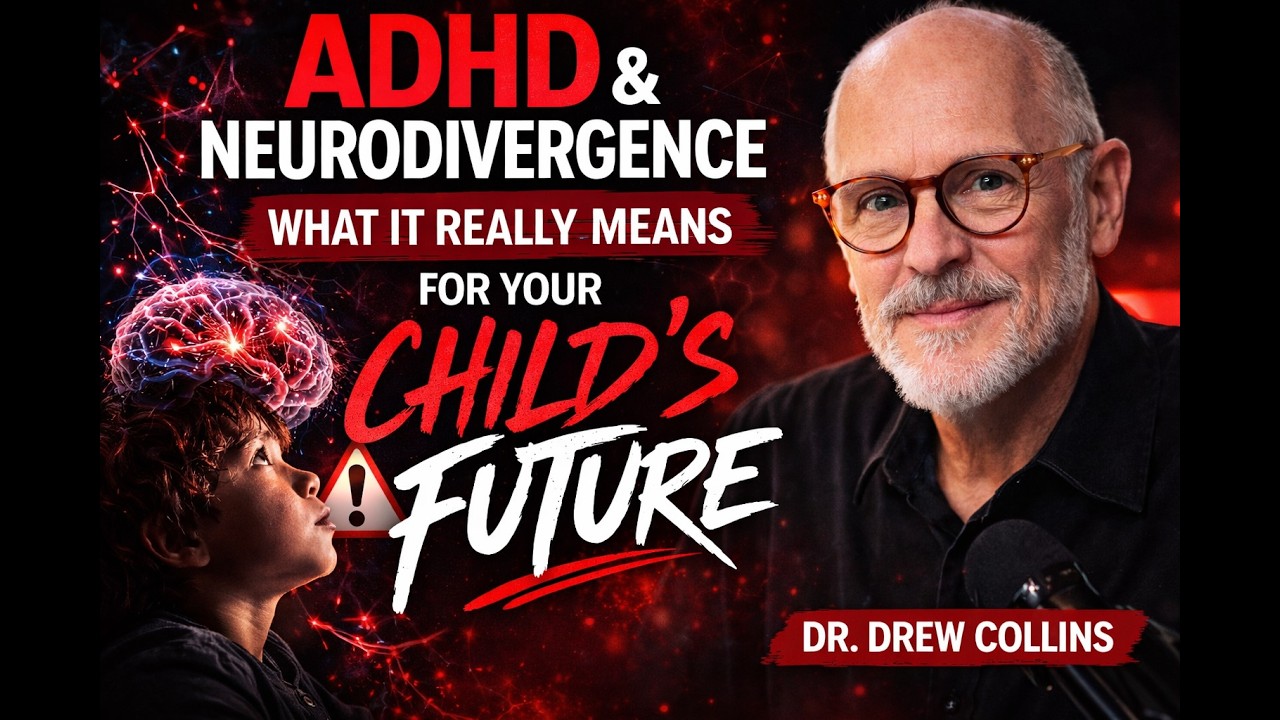
For most parents, an ADHD or autism-spectrum diagnosis starts — and often ends — with an observation, a checklist, and a prescription pad. In this conversation with host Mark Anthony, naturopathic doctor Dr. Drew Collins of Proactive Choice made the case for treating a diagnosis as a starting point rather than a life sentence, and for looking underneath the behavior at what might actually be driving it.
Collins has been in practice since earning his doctorate from Bastyr University in 1984 — 40-plus years of work spanning home births, cancer care, chelation therapy, pediatrics, and homeopathy, including a stretch as a founding clinical director and professor of naturopathic medicine. In 1992 he was named Arizona Naturopathic Physician of the Year. Today he's based in Bend, Oregon, where he runs Proactive Choice as a concierge practice — cash-based, membership-style direct access — consulting by phone and video with families around the country, often after a child has already been through a standard pediatric or psychiatric evaluation, been placed on medication, and the family is looking, in his words, for a "plan B."
Key Takeaways
- "Neurodivergent" is a broad, non-diagnostic umbrella term — covering ADHD, autism-spectrum conditions, dyslexia, Tourette's, and more — that Collins says has only come into common use in the last couple of decades.
- Standard ADHD and autism evaluations are observational, based on DSM-5 diagnostic codes, not a blood or lab test; Collins estimated roughly a 30% overlap between kids diagnosed with ADHD and those diagnosed on the autism spectrum.
- He offers a cheek-swab genetic test that screens for specific gene variants (SNPs) associated with certain mood, focus, and behavioral patterns — testing he says isn't part of standard insurance-based pediatric care.
- For patients whose testing shows relevant gene variants, Collins described using non-drug nutrient support — methylated B vitamins, folate, zinc, and B6 — an approach with roots in his early orthomolecular medicine work.
- Asked for three simple starting points any parent could try, Collins named exercise, consistent sleep (he said kids under 27 need roughly 10 hours), and a whole-food, lower-sugar diet.
What "Neurodivergent" Actually Means
Collins pointed out that ADHD-type behavior itself isn't new — he traced formal diagnosis back to the early 1900s — but the language around it is. "Neurodivergent" is a newer umbrella term, one he said became common only in the last couple of decades, meant to describe a wide population of kids without automatically labeling them as having something "wrong." It covers ADHD, autism-spectrum conditions, dyslexia, Tourette's, epilepsy, and other conditions — different wiring, in his telling, rather than a single diagnosis. He put the overlap between ADHD and autism-spectrum diagnoses at around 30%, and noted that today's diagnostic codes are observational: there's no blood test that produces an ADHD or autism diagnosis, just a specialist's assessment against DSM-5 criteria. He also referenced a colleague's long career as an informal data point — a clinician who has practiced for roughly 45 years told him that when he started out, about one in 10,000 kids were diagnosed as autistic, and that today that same clinician estimates it's closer to one in 30 — a shift Collins said cuts across income levels, not just affluent families with easier access to evaluation.
"It's not just a behavioral problem, like, make that kid work harder or something like that. It's genetic."
— Dr. Drew CollinsGenetic Testing and Targeted Nutrient Support
Much of the conversation centered on a cheek-swab genetic test Collins uses that looks for single nucleotide polymorphisms, or SNPs — small variations in specific genes he said show up more often in kids with these mood and attention differences. He described one case from his practice involving a child conceived using a donor egg, where testing showed relevant genetic variants traced to three sources — both intended parents and the egg donor — helping the family understand a pattern that hadn't been explained by either parent's own history alone. Where relevant variants show up, Collins said he supports patients with non-drug options — methylated B vitamins, methylated folic acid, zinc, and B6 — an approach he traces back to early work in orthomolecular medicine. He also pointed to homocysteine, a marker connected to cardiovascular risk, as something he said can build up in kids with these gene variants if left unaddressed.
Food Sensitivities, Sleep, and Other Daily Habits
Collins also uses IgG (immunoglobulin G) food-sensitivity testing, which he distinguished from the immediate-reaction scratch tests a typical pediatrician runs. IgG reactions, he said, are delayed — a trigger food eaten today might not show up as a migraine, a meltdown, or a digestive symptom until days later, which makes the connection easy to miss. In his experience, he said, identifying and removing trigger foods can address a meaningful share of a child's behavioral symptoms.
Asked directly for three simple things a parent could start today, Collins named exercise ("free," and "good for everything"), consistent sleep (he said kids under 27, whose brains are still developing, need roughly 10 hours a night, and screen time is often the first thing cutting into it), and diet — favoring whole foods around the perimeter of the grocery store over processed food, added sugar, and artificial dyes. He also talked about matching a child's individual learning style — visual, auditory, hands-on — rather than a one-size-fits-all classroom approach, and reframed "stimming," repetitive self-soothing behaviors like tapping, pacing, or fidgeting, as a kid's own way of regulating dopamine — something he said parents can redirect toward calmer, more sustainable outlets, like time with a pet.
Who This Conversation Is For
Collins was candid that families living with a hard-to-manage diagnosis often go quiet about it — ashamed to compare notes with other parents, worn down by disagreements between parents about how to handle it, and stretched thin by a school system he described as often too under-resourced to give any one child much individual attention. His message to those parents, repeated throughout the conversation, was less about a specific protocol and more about reassurance: that a difficult diagnosis today isn't a life sentence, that there are non-drug options worth exploring alongside — not necessarily instead of — whatever a family's own pediatrician or psychiatrist has already recommended, and that the goal isn't to make a child "normal" but to help them function without losing what makes them who they are.
"If you have a kid that's hard to handle, just know that they're going to be very interesting adults — and the world needs them."
— Dr. Drew Collins