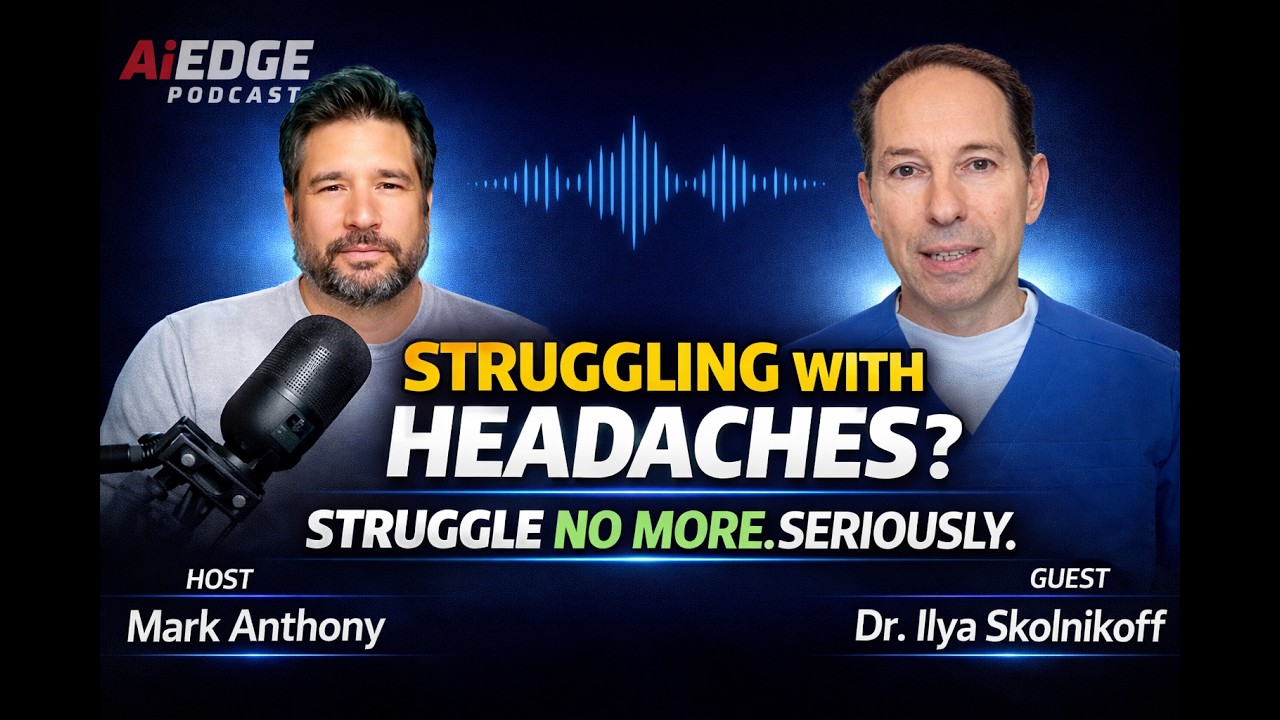
Mark Anthony has interviewed a lot of guests on Great Minds of Today, but this one started as something other than an interview. Years after first talking with Dr. Ilya Skolnikoff on an earlier podcast, Mark drove from Vancouver, Washington, through Portland, all the way down to Skolnikoff's practice in Northern California — not to record a show, but as a patient chasing relief from headaches he had lived with for most of his life.
Skolnikoff is a chiropractor whose practice centers on applied kinesiology, a muscle-testing-based diagnostic approach. He treats every health concern, in his words, as having a structural, a chemical, and an emotional component — not just one isolated cause. He calls his overall framework the Skolnikoff Method, the subject of his book on root-cause, whole-body care. His own path into the field was shaped in part by friction with his late father, a psychiatrist who paid for Skolnikoff's chiropractic education but, by Skolnikoff's account, never fully embraced ideas like muscle testing or epigenetics that his son tried to share with him over the years — and who Skolnikoff says never let him help manage the heart disease, prostate cancer, and lymphoma that eventually took his life.
Key Takeaways
- Host Mark Anthony described going from monthly, debilitating headaches for decades to roughly one headache a year after a single extended visit with Dr. Skolnikoff.
- Skolnikoff's approach is exam-first: he says he has to find "the right starting point" — what led to the symptom in the first place — before any treatment begins.
- His core diagnostic tool, applied kinesiology, treats each health concern as having a structural, chemical, and emotional component, not a single root cause.
- He described thyroid disease, autoimmune conditions, and hormone imbalance as frequently interconnected, and noted that standard blood labs can miss the active, "free" thyroid hormone that a saliva test may capture.
- He referenced another patient, Betsy Nicholas, whose severe headaches — alongside a recent Hashimoto's diagnosis — improved substantially within two treatment visits, by his account.
A Lifetime of Headaches, Resolved in a Single Extended Visit
By his own account on the show, Mark had been getting headaches since childhood in the 1980s, and they grew progressively worse until 2023. Near the end of nearly every month, he said, he'd get headaches so severe he'd throw up, need the lights dark, and miss work automatically — three days straight, month after month, for most of his adult life. "I'm 49 — half my life, ever since I was a kid in the 80s," he said on the show.
When Mark finally went to see Skolnikoff in person, he expected a typical short office visit. Instead, Skolnikoff spent roughly two hours with him in one sitting. Later in the conversation, both men clarified that it had really been a single extended visit — Skolnikoff, aware Mark had traveled hundreds of miles to get there, had effectively folded what might normally be spread across several appointments into that one session. Recapping the case later in the episode, Skolnikoff put the improvement at roughly 97 to 98 percent — Mark going from three or four headaches a month, with time off work each time, to about one headache a year. Mark's own description matched it: "I'm lucky if I even get a headache anymore," he said, adding that when he does get one now, he can usually trace it to something specific, like stress.
"If you're struggling with headaches, he'll not only find where the root of it's coming from — he'll show you how to kick it out, how to get rid of it."
— Mark Anthony, hostInside the Skolnikoff Method: Finding the Root Cause First
Skolnikoff was direct about the order of operations he follows with every patient: "We diagnose, then we provide the therapy, then we observe the results — we have to do it in that order." Skipping the diagnostic step, in his view, is how patients end up treating symptoms indefinitely without ever addressing what caused them.
Over the course of the episode he described the range of tools that can go into that diagnostic picture: postural blood pressure checks taken seated, standing, and lying down; a zinc taste test; an iodine skin test; an oral pH test; saliva-based hormone testing; and applied-kinesiology muscle testing, among others. The goal, as he put it, is getting to "the right starting point" — reconstructing what happened over a patient's life that led to the symptom in front of him — before deciding on a course of treatment.
Beyond Headaches: Connecting Thyroid, Hormones, and Chronic Symptoms
A recurring theme of the conversation was Skolnikoff's view that conditions often diagnosed and treated separately — thyroid disease, autoimmune conditions, mood disorders, hormone imbalance, digestive issues — are frequently connected rather than isolated. As one example, he walked through the difference between "bound" (inactive) and "free" (active) thyroid hormone, arguing that a standard blood lab mostly measures the bound form, while a saliva test can better capture the small fraction of active hormone that actually drives change in tissue throughout the body.
He also referenced another patient he's worked with, Betsy Nicholas, who came to him with severe headaches on top of a recent Hashimoto's thyroiditis diagnosis and a bout of Bell's palsy. By his account, her headaches and broader symptoms improved substantially within two treatment visits, and she was able to work with him to move off medications she had been taking for her thyroid condition — under his continued care, not on her own. Skolnikoff was clear elsewhere in the episode that his practice isn't a substitute for emergency or acute medical care, and that patients should never stop a prescribed medication without guidance from the physician who prescribed it.
Who This Conversation Is For
If you've been dealing with recurring headaches — or you've been told your labs are "normal" while you still don't feel like yourself — this episode is a look at how one root-cause-focused practitioner approaches that gap, in his own words, from someone the host sought out first as a patient, long before this interview.