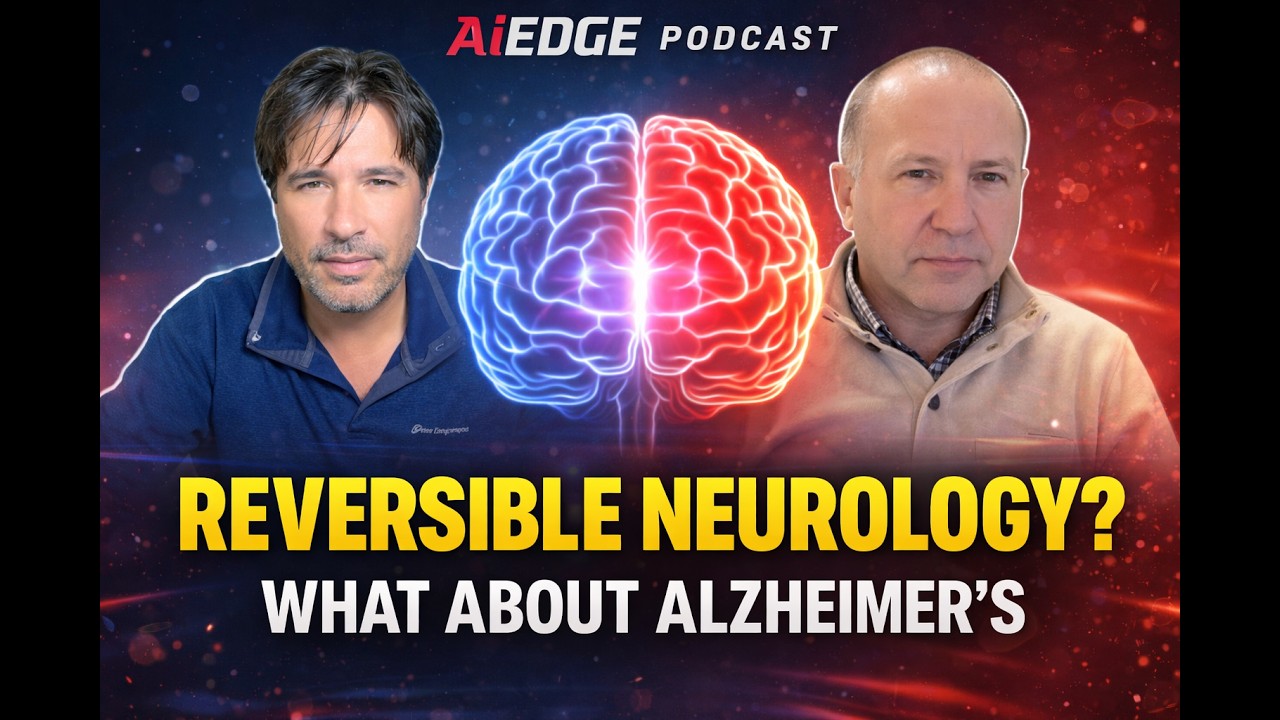
Most conversations about Alzheimer's disease start from a place of resignation — a diagnosis handed down, a slow decline assumed to be inevitable. Neurologist Dr. Ken Sharlin, returning to Great Minds of Today after a previous appearance on the show, spent this hour-long conversation with Mark Anthony making a different case: that neurological conditions many people assume only move in one direction — Alzheimer's chief among them, but in his experience also multiple sclerosis and Parkinson's — can sometimes be caught early, slowed, or in select cases meaningfully reversed.
Sharlin has practiced neurology for more than 30 years and opened Sharlin Health and Neurology in Ozark, Missouri, a suburb of Springfield, about a decade ago. Since then his practice has evolved from conventional neurology into functional medicine — which he described as "applied behavioral medicine" focused on root causes rather than symptom management — and, over the past several years, into regenerative medicine, including hands-on work with stem cell therapy. He also hosts his own podcast, The Healthy Brain Toolbox.
Key Takeaways
- "Reversible neurology" is Sharlin's term for a shift in framing: he says some neurological conditions long assumed to be one-way declines — Alzheimer's among them, and in his practice also MS and Parkinson's — can sometimes be caught early, slowed, or reversed.
- Alzheimer's disease can have a 10-to-20-year "preclinical" run-up, when brain changes are already underway but the brain is still compensating and no symptoms have appeared — the window Sharlin says matters most.
- Genetic testing for APOE4 and a blood test for a biomarker called p-tau217 can flag risk well before symptoms — but Sharlin was careful to say a positive result doesn't guarantee someone will develop Alzheimer's.
- Sharlin described a patient he'd followed for about five years whose p-tau217 result converted from positive to negative under his functional medicine program — by his account, the underlying disease markers were no longer detectable.
- Metabolic and vascular health — obesity, diabetes, sleep apnea, insulin resistance — are, in Sharlin's telling, often bigger accelerants of Alzheimer's risk than family history alone, and stem cell therapies "won't fix" that underlying picture on their own.
What "Reversible Neurology" Means
The term itself, Sharlin said, grew out of a branding conversation with a marketing consultant about how to describe his work — the underlying idea is less a formal diagnosis than a reframe: patients and physicians alike have been "programmed" to think of neurological decline as a one-way street, when in his clinical experience that isn't always true. He said the same underlying philosophy applies not just to Alzheimer's but to multiple sclerosis and Parkinson's as well — in his own clinic, he estimates roughly half of his MS patients are not on standard disease-modifying therapy, with disease activity tracked through other data rather than the annual MRI that's typical of conventional monitoring.
For Alzheimer's specifically, Sharlin was direct: "Alzheimer's disease is reversible," he said — before immediately grounding the claim in a specific case. He described a patient he'd been following for about five years, first diagnosed through blood testing early in that relationship, who came in for a repeat test the same day as the recording. It came back negative — meaning, by Sharlin's account, the underlying pathological markers (the amyloid and tau protein buildup that defines the disease) were no longer detectable. "He no longer meets that criteria," Sharlin said. "That's just one example. I have several in my practice."
He was equally clear that this isn't universal. For patients with more advanced dementia — where significant brain tissue and nerve-cell connections have already been lost — full reversal is harder to achieve. But he pointed to emerging research on stem cell-based treatments in more advanced patients showing meaningful gains on standard cognitive testing, even without a cure.
"We may not cure it at that point, but we can make a difference."
— Dr. Ken SharlinCatching It Early: APOE4 and the p-tau217 Blood Test
A recurring theme of the conversation was timing. Sharlin described Alzheimer's as a disease with a "preclinical" run-up that can last 10 to 20 years — a period when pathological changes are already underway in the brain, but the brain is compensating well enough that the person functions normally and shows no outward symptoms. By the time family members start noticing repeated questions, forgotten conversations, or word-finding trouble, he said, the disease has typically been active for years already.
Genetics play a role, though Sharlin was careful to frame it as one risk factor among several. The gene variant APOE4 is present in roughly 30% of the population (compared to about 60% for the more common APOE3, and about 10% for the mildly protective APOE2), and, by Sharlin's account, carrying one copy raises the risk of late-onset Alzheimer's roughly threefold, while carrying two copies — one from each parent — raises it 12- to 15-fold. He noted risk varies somewhat by ethnicity and that APOE status can be checked with an inexpensive at-home cheek-swab kit, without necessarily going through a doctor; he mentioned Dynamic DNA, a company local to his area, as one option.
Beyond genetics, Sharlin pointed to a blood-based biomarker called p-tau217 (phosphorylated tau protein) as, in his words, "the single most important" measure currently available for flagging risk before symptoms appear — increasingly available through home testing paired with telemedicine follow-up and referral to a neurologist for confirmation. He was careful to temper that, too: citing very recent research, he said a positive p-tau217 result in someone with no cognitive symptoms doesn't guarantee they'll develop Alzheimer's. Researchers had modeled how long it might take — roughly 20 years for a cognitively normal 60-year-old, with that window narrowing at older ages.
He also stressed that metabolic and vascular health can compress that timeline considerably. He described a patient who attributed his cognitive decline entirely to a childhood bout of polio; Sharlin pushed back, pointing instead to the man's untreated obesity, diabetes, high blood pressure, and sleep apnea — the same risk factors that drive heart attack and stroke — as the more likely accelerants. "Everything that puts you at risk for a heart attack or a stroke," he said, "puts you at risk for Alzheimer's disease."
Stem Cells and Regenerative Medicine: Signaling Cells, Not Magic
Sharlin has spent roughly five years working directly with stem cell therapy, and he was careful throughout the conversation to draw distinctions the general public often misses. He traced the underlying idea back to his own medical training at Emory University in the 1980s, when researchers were implanting cultured neurons from embryonic tissue into patients' brains in an attempt to restore lost neurological function — research that lost federal funding under the Bush administration. The more current frontier, he said, is induced pluripotent stem cells: a patient's own ordinary cells, reprogrammed to behave like a different tissue type entirely. As a real-world example, he pointed to Japan, where the regulatory equivalent of the FDA has approved an induced pluripotent stem cell treatment for Parkinson's in which reprogrammed cells are guided into becoming dopamine-producing neurons and implanted directly into the brain — a striking proof of concept, he said, but purely investigational and unavailable in the U.S.
Most of what Sharlin uses in his own practice falls under mesenchymal stem cells, found in bone marrow and fat tissue. He credited researcher Arnold Caplan — who first characterized these cells — with later arguing they'd be better described as "medicinal signaling cells," since their main effect appears to be releasing growth factors, anti-inflammatory signals, and repair signals rather than literally becoming new brain tissue. Sharlin harvests these from a patient's own bone marrow or fat (via a brief aspiration or mini-liposuction procedure) and administers them back to the same patient — an autologous approach he strongly prefers over donor-derived cells like those sourced from umbilical cord or placental tissue, which he flagged as less-studied and, in the hands of some practitioners, operating in "a gray area" of FDA oversight.
Delivery method matters too, he said. Intravenous administration can trap a share of cells in the lungs before they ever reach the brain, and not all of them cross the blood-brain barrier. In his own practice, Sharlin instead administers cells into the spinal fluid — an intrathecal injection — and currently relies primarily on bone marrow-derived cells because of the federal regulatory framework, though he expects the field to shift toward fat-derived cells over time. He was blunt about the limits: stem cells alone won't undo the damage of untreated obesity, diabetes, or sleep apnea. "That money you spent on this stem cell treatment is probably not going to help you," he said of that scenario, "because we're kind of putting clean water into a bucket of muddy water."
For multiple sclerosis specifically, Sharlin also described a more aggressive, hospital-based option performed at academic centers like Northwestern University: hematopoietic stem cell transplant, in which a patient's own blood-derived stem cells are collected, an immune-ablative drug wipes out the existing bone marrow and its overactive immune cells, and the banked stem cells are reinfused to rebuild the immune system. He called the outcomes "astonishing" for appropriately selected, treatment-resistant MS patients, while acknowledging the treatment carries a real period of immune vulnerability.
The Root-Cause Approach — and Who This Conversation Is For
Sharlin described his actual clinical process as considerably longer than a standard visit: an in-depth history and physical exam, blood-based biomarker testing well beyond a standard annual panel (looking at inflammation, oxidative stress, hormones, toxin exposure, and genetics), and then what he called a "5,000-piece jigsaw puzzle" — assembling those findings into a personalized plan that combines lifestyle changes, targeted supplementation, and, where appropriate, regenerative treatments. He was clear that ongoing tracking is central to the approach: retesting biomarkers over time to confirm a patient is trending in the right direction, and adjusting course if the data says otherwise.
Diet came up specifically: Sharlin pointed to the MIND diet, a modified Mediterranean approach, as mainstream, well-studied evidence — not "woo-woo," in his words — for both helping prevent Alzheimer's and improving cognitive function in people already affected. He also noted a more specific mechanism: adequate hydration helps blunt a process called glutamate excitotoxicity, a driver of neurodegeneration relevant to Alzheimer's, ALS, and other conditions, while dehydration can worsen it.
Sharlin was also candid that his approach isn't a replacement for medication when medication is genuinely needed — he described himself as not "against medication," just cautious about reaching for a prescription before other options have been explored. This conversation is likely most useful for people with a family history of Alzheimer's, or their own early memory concerns, who want to understand what proactive testing and root-cause options actually look like, as well as anyone curious how a working neurologist thinks about MS and Parkinson's outside the standard treatment path. As with any guest featured here, it reflects one physician's clinical experience and philosophy, not a guarantee of results for any individual patient.