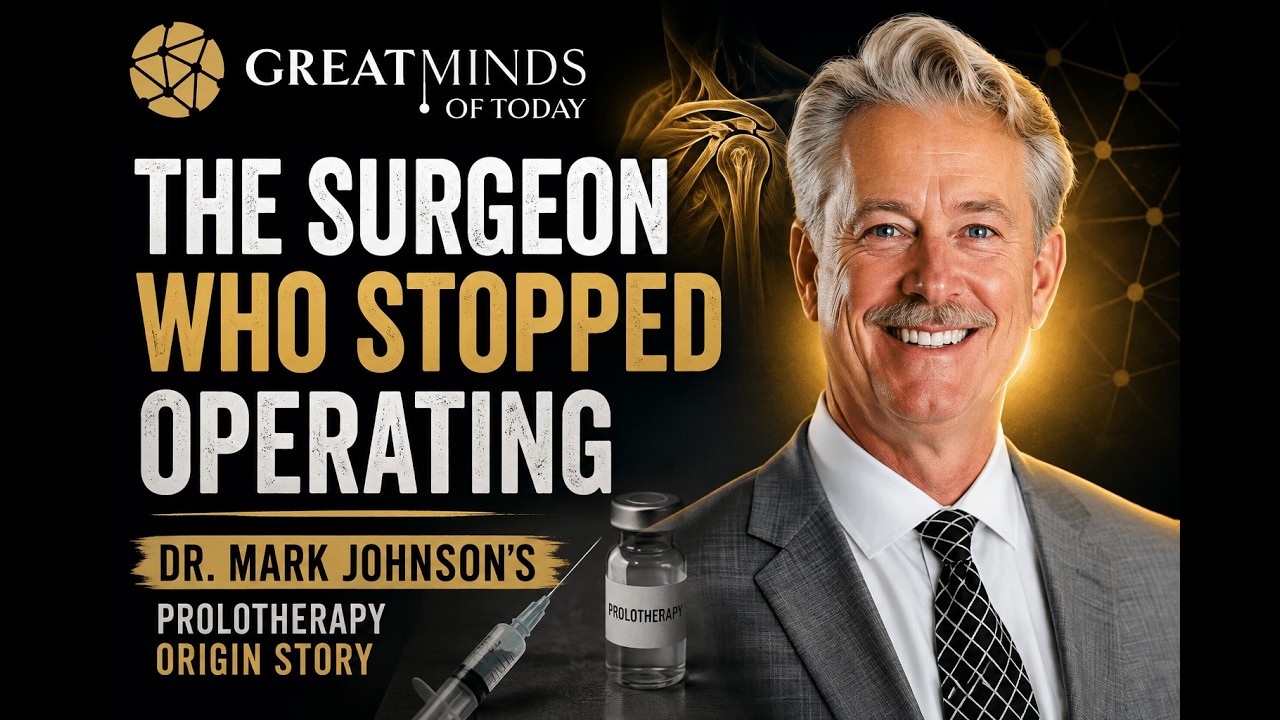
Dr. Mark Johnson, MD, FACS is a board-certified surgeon who spent twenty-five years practicing urology before he stepped away from a top-tier surgical practice to found Prolotherapy Nashville. The reason wasn't a loss of faith in surgery. It was his own back, which he carried a problem with for twenty-five years — the same span as his surgical career — before a respected fusion surgeon couldn't tell him where the pain was actually coming from.
Key Takeaways
- Dr. Johnson carried a back problem for twenty-five years — the same length as his surgical career — before it became disabling enough to force a decision.
- A well-regarded fusion surgeon reviewed his MRI, found multiple structural abnormalities, but couldn't answer Dr. Johnson's own two diagnostic questions: where, specifically, was the pain coming from, and what would the operation do about it.
- A Chicago colleague and residency-era friend — Ross Hauser, MD, who had taken over the late Gus Hemwall's prolotherapy practice — found tender ligament and pelvic structures on physical exam and treated them. Dr. Johnson got up off the table with no back pain for the first time in five or six years.
- His treatment philosophy, published in the Journal of Prolotherapy (2009) as "Connective Tissue Damage Syndrome," holds that most chronic joint, back, and neck pain traces to weakened, collagen-depleted ligaments and tendons — not inflammation.
- Across his own tracked outcomes, roughly 90% of patients end treatment with few or no symptoms; among patients told beforehand they needed a knee replacement, 95% had few or no symptoms at five-year follow-up.
- He and his wife Holly started the practice one day a week in a borrowed dental office; it grew, without paid advertising, to patients from every state and dozens of countries.
The Two Questions His Surgeon Couldn't Answer
Twenty-five years into a surgical career that included urology residency at the University of Illinois in Chicago — with Cook County Hospital making up roughly half his training caseload — Dr. Johnson was still carrying a back problem that had started decades earlier, laying railroad ties for a flower bed at his first house. What began as an occasional lockup became, over five or six years, constant pain and a visibly bent gait. He had the run of the best back surgeons at his own hospital. The one he chose reviewed the MRI and found real findings: three deteriorated discs, a fourth ruptured against a nerve root, a vertebra out of alignment, arthritic facet changes. The recommendation was a multi-level spinal fusion.
Before agreeing to surgery, Dr. Johnson asked two questions any surgeon should expect: "Where amongst all those findings is my back pain actually coming from?" and "What is your operation going to do to fix that?" His surgeon's answer was candid but unsatisfying: there was real debate about where the pain was actually coming from, and outcomes from that kind of fusion were mixed — "a lot of people feel better, some don't, some feel worse" — so the advice was to put the operation off as long as possible, "like maybe forever." For a surgeon trained never to operate without a precise diagnosis, that was the moment the question stopped being academic.
"Where amongst all those findings is my back pain actually coming from? And what is your operation going to do to fix that?"
— Dr. Mark Johnson, on the two questions his own surgeon couldn't answerWhat a Colleague Found With His Hands
About a month later, having dinner in Chicago with a residency-era friend — Ross Hauser, MD, who by then had taken over the practice of Gus Hemwall, principal disciple of prolotherapy founder George Hackett — Dr. Johnson was examined on the spot. Pressing along his spine and pelvis, Dr. Hauser found specific ligament and tendon structures that were sharply tender, and offered to treat them by triggering Dr. Johnson's own healing system. Skeptical based on his own surgical training, Dr. Johnson first went back to his hospital's medical library and found more than 550 published papers on prolotherapy dating to the mid-1930s. He agreed to treatment at a free clinic Dr. Hauser runs several times a year. "When I got up off the table for the first time in five or six years, I had absolutely no back pain," he said.
Why "Itis" Doesn't Mean What Medicine Assumed
That result raised an obvious question: if it wasn't the herniated disc or the misaligned vertebra, what was actually being fixed? Dr. Johnson traces the field's confusion to the 1950s, when cortisone arrived as the first widely used anti-inflammatory and clinicians assumed the pain it relieved must be inflammatory — hence the "-itis" suffix across arthritis, tendinitis, and related diagnoses. Tissue studies that later looked directly for inflammation in chronically painful tendons repeatedly found degeneration instead, part of why the sports-medicine field shifted its own terminology from "tendinitis" toward "tendinosis."
How Prolotherapy Actually Works
Prolotherapy uses a concentrated dextrose solution, sometimes combined with PRP, injected directly into weakened ligament or tendon tissue. The solution triggers the same collagen-production healing response the body runs after any significant injury, over roughly a month per treatment cycle. As the structure rebuilds tensile strength and stops stretching under normal load, Dr. Johnson says, the pain it was generating resolves — and in weight-bearing joints, the abnormal motion grinding down cartilage stops with it. "You can find the pain sources with my hand vastly more accurately than you can by looking at any imaging study," he said, a claim built on roughly twenty years and an estimated eleven to twelve thousand patients. His own published framework for the underlying mechanism, Connective Tissue Damage Syndrome, appeared in the Journal of Prolotherapy in 2009.
The Numbers Behind the Claim
Across his own tracked outcomes, Dr. Johnson reports that roughly nine in ten patients — about 90% — end treatment with few or no symptoms. "I do not think anybody in the country is matching those results," he said. For patients who came in already told they needed a knee replacement — tracked in three separate cohorts followed to one, two and a half, and five years — 95% had few or no symptoms at the five-year mark. Multiple randomized, placebo-controlled trials on dextrose prolotherapy for knee osteoarthritis, along with a 2016 systematic review, back the general mechanism; his own practice publishes the primary research citations on its site.
From a Borrowed Room to a Full Practice
Dr. Johnson didn't set out to build a second medical practice. "We did not plan a practice. I already had a practice. I liked my practice," he said. His wife Holly — a dental hygienist at the time, treated by the same method after her own serious car-accident injury — started seeing patients with him one day a week, in a borrowed room at her dentist's office with a single massage table. Word of mouth grew the schedule past one day a week; Holly gave notice at her job, and within about a year and a half Dr. Johnson had left urology entirely. Prolotherapy Nashville has since treated patients from every state and dozens of countries, without paid advertising.
Who Prolotherapy Nashville Treats
The practice, based in Brentwood, Tennessee, treats patients facing recommendations for knee, hip, shoulder, and spine surgery, along with chronic neck pain, sciatica, and plantar fasciitis — and, per Dr. Johnson, a smaller but real population with referred symptoms (tinnitus, migraine-like head pain, radiating limb symptoms) traced to cervical connective tissue damage. He's clear that surgery still has its place: "None of this means surgery is never the right call," he says of cases where soft-tissue healing genuinely can't address the underlying damage. His stated position is narrower and more specific — that patients deserve a precise answer to where their pain is actually coming from before consenting to an operation, not after.
Credentials & Training
- MD, University of Alabama School of Medicine, Birmingham, AL
- Urology Residency, University of Illinois at Chicago (Cook County Hospital)
- Board Certified, Urology
- Fellow, American College of Surgeons (FACS)
- Published: "Prolotherapy & Connective Tissue Damage Syndrome," Journal of Prolotherapy, Vol. 1, Issue 1, February 2009
About Prolotherapy Nashville
- Founder & physician: Dr. Mark L. Johnson, MD, FACS
- Practice focus: prolotherapy (dextrose injection therapy) and PRP for chronic joint, back, and neck pain
- Location: 278 Franklin Rd, Suite 150, Brentwood, TN 37027
- Phone: 615-506-0536
Learn more or get in touch: prolotherapynashville.com